Advertisements
Advertisements
Observe the following picture and answer the following questions:
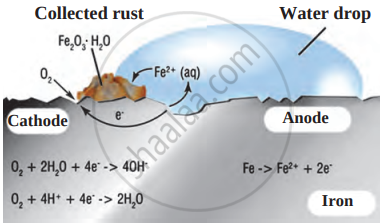
- What is rust?
- Write the chemical formula of rust.
- Write the reaction of oxidation of iron at the anode.
- Write the reaction of oxidation of iron at the cathode.
- What is corrosion?
Concept: Corrosion of Metals
Extraction of moderately reactive elements is done by _______ and _______ method.
Concept: Basic Principles of Metallurgy > Extraction of Metals
Write scientific reason.
On exposure to air, silver articles turn blackish after some time.
Concept: Corrosion of Metals
Explain the characteristics of ionic compounds.
Concept: Basic Principles of Metallurgy > Extraction of Metals
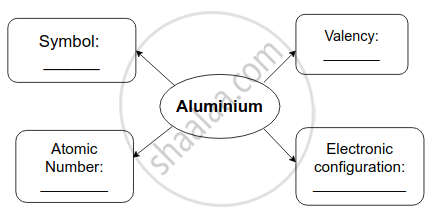
Complete flow chart given below.
Concept: Basic Principles of Metallurgy > Extraction of Metals
Answer the questions on the following passage.
The minerals from which the metal can be separated economically are called ores. Ores contain many types of impurities such as soil, sand and rocky substances along with metal compounds. These impurities are called gangue.
Metals can be extracted from their ores by means of various methods of separation. The process of extraction of metal in a pure state from the ores is also a part of metallurgy.
Ores are taken out from the mines and the gangue is usually separated from the ore at the site itself by various methods. Then the ores are carried out to the place where metals are produced. Here metals are extracted in pure form. Then metals are further purified by different methods of purification. This entire process is called metallurgy. Most metals being reactive do not occur in nature in the free state but are found in combined state as their salts such as oxides, carbonates, sulphides, and nitrates. however, the most unreactive metals that are not affected by air, water and other natural factors like silver, gold, platinum, generally occur in a free state. The compounds of metals that occur in nature along with the impurities are called minerals.
- What are ores?
- Which processes are involved in the branch of metallurgy? What is metallurgy?
- Which metals are found in a free state?
- In what forms are metals found in combined state?
- What is gangue?
Concept: Basic Principles of Metallurgy > Extraction of Metals
Gold plated ornaments is the example of ______.
Concept: Corrosion of Metals
Give scientific reasons.
Silver amalgam is used for filling dental cavities.
Concept: Corrosion of Metals
| A process of forming a thick oxide of aluminium when aluminium is exposed to air. This coat makes it resistant to corrosion. Resistance can be improved by making a layer of oxide thinker. In this technique, the aluminium article is the anode, and the electrolyte is sulphuric acid. The anode reaction results in the formation of a black-coloured film of aluminium oxide on the anode. By putting appropriate dyes in the electrolytic solution, both coloured surface with the decorative finish is achieved. Kitchen articles like anodised such as pressure cookers, pans and frames of sliding windows are applications of this technique. |
- Name the anode and electrolyte used in this technique.
- How can we make aluminium articles made resistant to corrosion?
- Name the technique used to coat the aluminium articles.
Concept: Corrosion of Metals
Answer the questions based on the figure below:

- Which reaction is shown in the figure?
- Which gas is evolved in the reaction?
- Give an example of reactants that rapidly show this reaction. Give equations.
- Give an example of reactants that do not react rapidly.
- In what condition will reactants of (c) part react? Give equation.
Concept: Chemical Properties of Metal
In ______ process a layer of molten tin is deposited on metals.
Concept: Corrosion of Metals
Corrosion can be prevented by using ……………. solution.
Concept: Chemical Properties of Carbon Compounds > Oxidation
The chemical formula for rust is.............. .
Concept: Chemical Properties of Carbon Compounds > Oxidation
What is meant by rust?
Concept: Chemical Properties of Carbon Compounds > Oxidation
Write the chemical formula of rust.
Concept: Chemical Properties of Carbon Compounds > Oxidation
Give scientific reason.
It is reccommended to use air tight container for storing oil for long time.
Concept: Chemical Properties of Carbon Compounds > Oxidation
Identify from the reaction the reactants that undergo oxidation and reduction.
Fe + S → FeS
Concept: Chemical Properties of Carbon Compounds > Oxidation
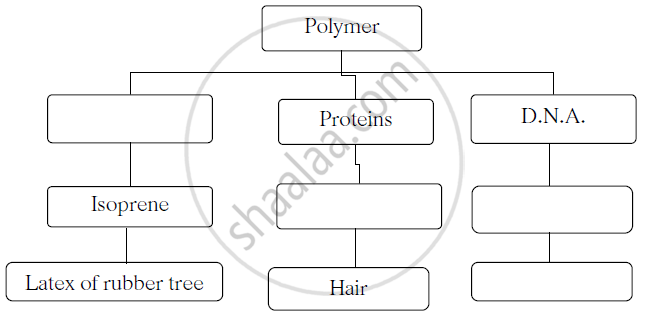
Complete the following flow chart.
Concept: Macromolecules and Polymers
