Please select a subject first
Advertisements
Advertisements
Name the method of refining of metals such as Germanium.
Concept: Refining of Crude Metals
What is the role of silica in the extraction of copper?
Concept: Occurrence of Metals
Give simple chemical tests to distinguish between the following pairs of compounds: Benzoic acid and Phenol
Concept: Chemical Properties of Phenol
How do you convert the following :
Phenol to anisole
Concept: Preparation of Ethers
Write the structures of the following molecule:
XeOF4
Concept: Group 18 Elements - The Noble gas Family
Write the mechanism of the following reaction :

Concept: Chemical Reactions of Alcohols and Phenols >> Reactions Involving Cleavage of Carbon–Oxygen (C–O) Bond in Alcohols
Find the area of the region in the first quadrant enclosed by the x-axis, the line y = x and the circle x2 + y2 = 32.
Concept: Area Under Simple Curves
State two points of difference between the interference patterns obtained in Young’s double slit experiment and the diffraction pattern due to a single slit.
Concept: Diffraction of Light >> The Single Slit
Write the two processes that take place in the formation of a p-n junction.
Concept: p-n Junction
Describe how do 'flocs' and 'activated sludge' help in Sewage Treatment.
Concept: Microbes in Sewage Treatment
Suggest two advantages to a farmer for using apomictic seeds of hybrid varieties.
Concept: Strategies for Enhancement in Food Production (Questions)
Calculate the e.m.f. of the following cell at 298 K:
Fe(s) | Fe2+ (0.001 M) | | H+ (0.01 M) | H2(g) (1 bar) | Pt(s)
Given that \[\ce{E^0_{cell}}\] = 0.44 V
[log 2 = 0.3010, log 3 = 0.4771, log 10 = 1]
Concept: Nernst Equation - Introduction
For a reaction A + B ⟶ P, the rate is given by
Rate = k [A] [B]2
How is the rate of reaction affected if the concentration of B is doubled?
Concept: Factors Influencing Rate of a Reaction
For a reaction A + B ⟶ P, the rate is given by
Rate = k [A] [B]2
What is the overall order of reaction if A is present in large excess?
Concept: Factors Influencing Rate of a Reaction
For a chemical reaction R → P, the variation in the concentration (R) vs. time (t) plot is given as:
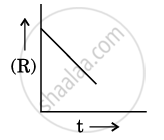
(i) Predict the order of the reaction.
(ii) What is the slope of the curve?
(iii) Write the unit of rate constant for this reaction.
Concept: Factors Influencing Rate of a Reaction
Account for the following:
Mn shows the highest oxidation state of +7 with oxygen but with fluorine, it shows oxidation state of +4.
Concept: General Properties of the Transition Elements (d-block)
Account for the following:
Cu+2 salts are coloured, while Zn2+ salts are white.
Concept: General Properties of the Transition Elements (d-block)
Give a reason for the following:
Actinoids show irregularities in their electronic configurations.
Concept: F-block Elements >> The Actinoids
Give an example and suggest a reason for the following feature of the transition metal chemistry:
The lowest oxide of transition metal is basic, the highest is amphoteric/acidic.
Concept: Some Important Compounds of Transition Elements - Oxides and Oxoanions of Metals
What is the reason for the stability of colloidal sols?
Concept: Properties of Colloidal Solutions
