CBSE Science (English Medium) इयत्ता १२ Important Questions for Physics - Dual Nature of Radiation and Matter
Advertisements
Advertisements
Chapter wise important questions with answers and solutions for Physics in CBSE Science (English Medium) इयत्ता १२.
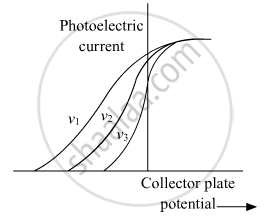
On the basis of the graphs shown in the figure, answer the following questions :
(a) Which physical parameter is kept constant for the three curves?
(b) Which is the highest frequency among v1, v2, and v3?
पाठ: [11] Dual Nature of Radiation and Matter
Use Einstein's photoelectric equation to show how from this graph,
(i) Threshold frequency, and
(ii) Planck's constant can be determined.
पाठ: [11] Dual Nature of Radiation and Matter
The work function of aluminum is 4⋅2 eV. If two photons each of energy 2⋅5 eV are incident on its surface, will the emission of electrons take place? Justify your answer.
पाठ: [11] Dual Nature of Radiation and Matter
Define the terms "stopping potential' and 'threshold frequency' in relation to the photoelectric effect. How does one determine these physical quantities using Einstein's equation?
पाठ: [11] Dual Nature of Radiation and Matter
Choose the correct answer from given options
Photons of frequency v are incident on the surface of two metals A and B of threshold frequency 3/4 v and 2/3 v, respectively. The ratio of maximum kinetic energy of electrons emitted from A to that from B is
पाठ: [11] Dual Nature of Radiation and Matter
In the case of a photo electric effect experiment, explain the following facts, giving reasons.
The wave theory of light could not explain the existence of the threshold frequency.
पाठ: [11] Dual Nature of Radiation and Matter
In the case of photoelectric effect experiment, explain the following facts, giving reasons.
The photoelectric current increases with increase of intensity of incident light.
पाठ: [11] Dual Nature of Radiation and Matter
Define the term: stopping potential in the photoelectric effect.
पाठ: [11] Dual Nature of Radiation and Matter
Explain how does (i) photoelectric current and (ii) kinetic energy of the photoelectrons emitted in a photocell vary if the frequency of incident radiation is doubled, but keeping the intensity same?
Show the graphical variation in the above two cases.
पाठ: [11] Dual Nature of Radiation and Matter
The work function for a metal surface is 4.14 eV. The threshold wavelength for this metal surface is ______.
पाठ: [11] Dual Nature of Radiation and Matter
Radiation of frequency 1015 Hz is incident on three photosensitive surfaces A, B and C. Following observations are recorded:
Surface A: no photoemission occurs
Surface B: photoemission occurs but the photoelectrons have zero kinetic energy.
Surface C: photo emission occurs and photoelectrons have some kinetic energy.
Using Einstein’s photo-electric equation, explain the three observations.
पाठ: [11] Dual Nature of Radiation and Matter
The graph shows the variation of photocurrent for a photosensitive metal
- What does X and A on the horizontal axis represent?
- Draw this graph for three different values of frequencies of incident radiation ʋ1, ʋ2 and ʋ3 (ʋ3 > ʋ2 > ʋ1) for the same intensity.
- Draw this graph for three different values of intensities of incident radiation I1, I2 and I3 (I3 > I2 > I1) having the same frequency.
पाठ: [11] Dual Nature of Radiation and Matter
An alpha particle is accelerated through a potential difference of 100 V. Calculate:
- The speed acquired by the alpha particle, and
- The de-Broglie wavelength is associated with it.
(Take mass of alpha particle = 6.4 × 10⁻²⁷ kg)
पाठ: [11] Dual Nature of Radiation and Matter
Give an example each of a metal from which photoelectric emission takes place when irradiated by
- UV light
- visible light.
पाठ: [11] Dual Nature of Radiation and Matter
The work function of a metal is 2.31 eV. Photoelectric emission occurs when the light of frequency 6.4 × 10¹⁴ Hz is incident on the metal surface. Calculate
- the energy of the incident radiation,
- the maximum kinetic energy of the emitted electron and
- the stopping potential of the surface.
पाठ: [11] Dual Nature of Radiation and Matter
A photon of wavelength 663 nm is incident on a metal surface. The work function of the metal is 1.50 eV. The maximum kinetic energy of the emitted photoelectrons is ______.
पाठ: [11] Dual Nature of Radiation and Matter
The energy of a photon of wavelength 663 nm is ______.
पाठ: [11] Dual Nature of Radiation and Matter
The figure shows a plot of stopping potential (V0) versus `1/lambda`, where λ is the wavelength of the radiation causing photoelectric emission from a surface. The slope of the line is equal to ______.

पाठ: [11] Dual Nature of Radiation and Matter
An increase in the intensity of the radiation causing photo-electric emission from a surface does not affect the maximum K.E. of the photoelectrons. Explain.
पाठ: [11] Dual Nature of Radiation and Matter
The photon emitted during the de-excitation from the first excited level to the ground state of a hydrogen atom is used to irradiate a photocathode in which the stopping potential is 5 V. Calculate the work function of the cathode used.
