मराठी

Science (English Medium) इयत्ता १२ - CBSE Important Questions

Advertisements
[object Object]
[object Object]
विषय
मुख्य विषय
अध्याय

Please select a subject first

Advertisements
Advertisements
< prev  61 to 80 of 6257  next > 

Illustrate the following reaction giving suitable example in each case: Diazotisation


Appears in 9 question papers
Chapter: [9] Amines
Concept: Diazonium Salts >> Method of Preparation of Diazonium Salts

Give reason (CH3)2NH is more basic than (CH3)3N in an aqueous solution.

Appears in 9 question papers
Chapter: [9] Amines
Concept: Physical Properties of Amines

Give reason Aromatic diazonium salts are more stable than aliphatic diazonium salts.

Appears in 9 question papers
Chapter: [9] Amines
Concept: Physical Properties of Diazonium Salts

Write the structures of the main products of the following reactions:

Appears in 9 question papers
Chapter: [9] Amines
Concept: Concept of Amines >> Chemical Reactions of Amines - Basic Character of Amines

Write the structures of the main products of the following reactions:

Appears in 9 question papers
Chapter: [9] Amines
Concept: Concept of Amines >> Chemical Reactions of Amines - Basic Character of Amines

Write the structures of the main products of the following reactions:

Appears in 9 question papers
Chapter: [9] Amines
Concept: Concept of Amines >> Chemical Reactions of Amines - Basic Character of Amines

Define the following with an example

Denatured protein

Appears in 9 question papers
Chapter: [10] Biomolecules
Concept: Biomolecules in the Cell > Proteins >> Denaturation of Proteins

Write the product when D-glucose reacts with conc. HNO3.

Appears in 9 question papers
Chapter: [10] Biomolecules
Concept: Biomolecules in the Cell > Carbohydrates >> Structures of Glucose

Write one difference between α-helix and β-pleated structures of proteins.

Appears in 9 question papers
Chapter: [10] Biomolecules
Concept: Biomolecules in the Cell > Proteins >> Structure of Proteins

Shyam went to a grocery shop to purchase some food items. The shopkeeper packed all the items in polythene bags and gave them to Shyam. But Shyam refused to accept the polythene bags and asked the shopkeeper to pack the items in paper bags. He informed the shopkeeper about the heavy penalty imposed by the government for using polythene bags. The shopkeeper promised that he would use paper bags in future in place of polythene bags.

1) Write the values (at least two) shown by Shyam.

2) Write one structural difference between low-density polyethene and high-density polyethene.

3) Why did Shyam refuse to accept the items in polythene bags?

4) What is a biodegradable polymer? Give an example.


Appears in 9 question papers
Chapter: [15] Polymers
Concept: Classification of Polymers> Based on Mode of Polymerisation

What is tincture of iodine? What is its use?

Appears in 9 question papers
Chapter: [16] Chemistry in Everyday Life
Concept: Compounds with Medicinal Properties >> Antimicrobials

Among the following, which one acts as a food preservative?

Aspartame, Aspirin, Sodium Benzoate, Paracetamol

Appears in 9 question papers
Chapter: [16] Chemistry in Everyday Life
Concept: Chemicals in Food - Artificial Sweetening Agents and Food Preservatives

Read the passage given below :

1. To ensure its perpetuity, the ground is well held by the panther both in space and in time. It enjoys a much wider distribution over the globe than its bigger cousins and procreates sufficiently profusely to ensure its continuity for all time to come.

2. There seems to be no particular breeding season of the panther, although its sawing and caterwauling is more frequently heard during winter and summer. The gestation period is about ninety to a hundred days (Whipsnade, ninety-two days). The litter normally consists of four cubs, rarely five. Of these, generally, two survive and not more than one reaches maturity. I have never come across more than two cubs at the heels of the mother. Likewise, graziers in the forest have generally found only two cubs hidden away among rocks, hollows of trees, and other impossible places.
 
3. Panther cubs are generally in evidence in March They are born blind. This is a provision of Nature, against, their drifting away from the place of safety in which they are lodged by their mother, and exposing themselves to the danger of their being devoured by hyenas, jackals, and other predators. They generally open their eyes in about three to four weeks.
 
4. The mother alone rears its cubs in seclusion. It keeps them out of the reach of the impulsive and impatient male. As a matter of fact, the mother separates from the male soon after mating and forgets all about their tumultuous union. The story that the male often looks in to find out how the mother is progressing with her cubs has no foundation except in what we wish it should do at least.
 
5. The mother carries its cubs about by holding them by the scruff of their neck in its mouth. It trains them to stalk and teaches them how to deliver the bite of death to the prey. The cubs learn to treat all and sundry with suspicion at their mother’s heels. Instinctively the cubs seek seclusion, keep to cover and protect their flanks by walking along the edge of the forest.
 
6. I have never had an opportunity to watch mother panther train its cubs. But in Pilibhit forests, I once saw a tigress giving some lessons to its little ones. I was sitting over its kill at Mala. As the sunset, the tigress materialized in the twilight behind my machan. For about an hour, it scanned and surveyed the entire area looking and listening with the gravest concern. It even went to the road where my elephant was awaiting my signal. The mahout spotted it from a distance and drove the elephant away.
 
7. When darkness descended upon the scene and all was well and safe, the tigress called its cubs by emitting a low haa-oon. The cubs, two in number and bigger than a full-grown cat, soon responded. They came trotting up to their mother and hurried straight to the kill in indecent haste. The mother spitted at them so furiously that they doubled back to its heels immediately. Thereafter, the mother and its cubs sat undercover about 50 feet (15 m) away from the kill to watch, wait, look, and listen. After about half an hour’s patient and fidget less vigil the mother seemed to say ‘paid for’. At this signal, the cubs cautiously advanced, covering their flanks, towards the kill. No longer did they make a beeline for it, as they had done before.
 
8. The mother sat watching its cubs eat. and mounted guard on them. She did not partake of the meal.
 
On the basis of your understanding of the above passage complete the statements given below with the help of options that follow :
 
(a) To protect its cubs the mother panther hides them
(i) among rocks
(ii) in the branches of the trees
(iii) behind the tree trunks
(iv) at its heels
 
(b) The male panther :
(i) is protective of its cubs
(ii) trains its cubs
(iii) watches the progress of the mother
(iv) is impulsive and impatient

Answer the following questions briefly :
 
(c) How many cubs does the mother panther rarely deliver?
 
(d) What may happen if the panther cubs are not born blind?
 
(e) Why did the mahout drive his elephant away?
 
(f) Why did the tigress spit at its cubs?
 
(g) From the narrator's observation, what do we learn about the nature of the tigress?
 
(h) Why does the panther not face the risk of extinction?
 
(i) Find words from the passage which mean the same as each of the following :
(i) moving aimlessly (para 3)
(ii) came down / fell (para 7)
Appears in 9 question papers
Chapter: [6] Reading Skills
Concept: Unseen Passage Comprehension

Read the passage given below:

People tend to amass possessions, sometimes without being aware of doing so. They can have a delightful surprise when they find something useful which they did not know they owned. Those who never have to change house become indiscriminate collectors of what can only be described as clutter. They leave unwanted objects in drawers, cupboards, and attics for years in the belief that they may one day need them. Old people also accumulate belongings for two other reasons, lack of physical and mental energy, and sentiment. Things owned for a long time are full of associations with the past, perhaps with the relatives who are dead, and so they gradually acquire a sentimental value.

Some things are collected deliberately in an attempt to avoid wastage. Among these are string and brown paper, kept by thrifty people when a parcel has been opened. Collecting small items can be mania. A lady cuts out from newspaper sketches of model clothes that she would like to buy if she had money. As she is not rich, the chances are that she will never be able to afford such purchases. It is a harmless habit, but it litters up her desk.

Collecting as a serious hobby is quite different and has many advantages. It provides relaxation for leisure hours, as just looking at one’s treasure is always a joy. One doesn’t have to go out for amusement as the collection is housed at home. Whatever it consists of - stamps, records, first editions of books, china – there is always something to do in connection with it, from finding the right place for the latest addition to verifying facts in reference books. This hobby educates one not only in the chosen subject but also in general matters which have some bearing on it.

There are other benefits also. One gets to meet like-minded collectors to get advice, compare notes, exchange articles, to show off one’s latest find. So one’s circle of friends grows. Soon the hobby leads to traveling, perhaps a meeting in another town, possibly a trip abroad in search of a rare specimen, for collectors are not confined to one country. Over the years one may well become an authority on one’s hobby and will probably be asked to give informal talks to little gatherings and then, if successful, to larger audiences.

(a) On the basis of your understanding of the above passage make notes on it using headings and sub-headings. Use recognizable abbreviations (wherever necessary-minimum four) and a format you consider suitable. Also, supply an appropriate title to it.

(b) Write a summary of the passage in about 80 words.

Appears in 9 question papers
Chapter: [6] Reading Skills
Concept: Unseen Passage Comprehension

Define electric flux.

Appears in 9 question papers
Chapter: [1] Electric Charges and Fields
Concept: Electric Flux

Four point charges Q, q, Q and q are placed at the corners of a square of side 'a' as shown in the figure.
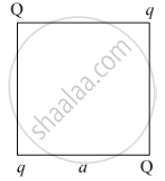
Find the

1) resultant electric force on a charge Q, and

2) potential energy of this system.

Appears in 9 question papers
Chapter: [2] Electrostatic Potential and Capacitance
Concept: Potential Energy of a System of Charges

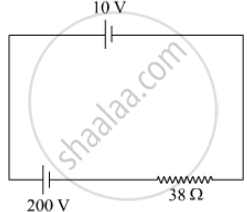
A 10 V cell of negligible internal resistance is connected in parallel across a battery of emf 200 V and internal resistance 38 Ω as shown in the figure. Find the value of current in the circuit.
Appears in 9 question papers
Chapter: [3] Current Electricity
Concept: Cells, Emf, Internal Resistance

Define the term 'conductivity' of a metallic wire. Write its SI unit.

Appears in 9 question papers
Chapter: [3] Current Electricity
Concept: Specific Resistance

State Ampere’s circuital law.

Appears in 9 question papers
Chapter: [4] Moving Charges and Magnetism
Concept: Ampere’s Circuital Law

A proton and an electron travelling along parallel paths enter a region of uniform magnetic field, acting perpendicular to their paths. Which of them will move in a circular path with higher frequency?

Appears in 9 question papers
Chapter: [4] Moving Charges and Magnetism
Concept: Cyclotron
< prev  61 to 80 of 6257  next > 
Advertisements
Advertisements
CBSE Science (English Medium) इयत्ता १२ Important Questions
Important Questions for CBSE Science (English Medium) इयत्ता १२ Biology
Important Questions for CBSE Science (English Medium) इयत्ता १२ Chemistry
Important Questions for CBSE Science (English Medium) इयत्ता १२ Computer Science (C++)
Important Questions for CBSE Science (English Medium) इयत्ता १२ Computer Science (Python)
Important Questions for CBSE Science (English Medium) इयत्ता १२ English Core
Important Questions for CBSE Science (English Medium) इयत्ता १२ English Elective - NCERT
Important Questions for CBSE Science (English Medium) इयत्ता १२ Entrepreneurship
Important Questions for CBSE Science (English Medium) इयत्ता १२ Geography
Important Questions for CBSE Science (English Medium) इयत्ता १२ Hindi (Core)
Important Questions for CBSE Science (English Medium) इयत्ता १२ Hindi (Elective)
Important Questions for CBSE Science (English Medium) इयत्ता १२ History
Important Questions for CBSE Science (English Medium) इयत्ता १२ Informatics Practices
Important Questions for CBSE Science (English Medium) इयत्ता १२ Mathematics
Important Questions for CBSE Science (English Medium) इयत्ता १२ Physical Education
Important Questions for CBSE Science (English Medium) इयत्ता १२ Physics
Important Questions for CBSE Science (English Medium) इयत्ता १२ Political Science
Important Questions for CBSE Science (English Medium) इयत्ता १२ Psychology
Important Questions for CBSE Science (English Medium) इयत्ता १२ Sociology
Share
Notifications

Englishहिंदीमराठी


      Forgot password?
Use app×