CBSE Science (English Medium) इयत्ता १२ Important Questions for Physics - Current Electricity
Advertisements
Advertisements
Chapter wise important questions with answers and solutions for Physics in CBSE Science (English Medium) इयत्ता १२.
A current of 0.8 A flows in a conductor of 40 Ω for 1 minute. The heat produced in the conductor will be ______.
पाठ: [3] Current Electricity
A cell of emf E is connected across an external resistance R. When current 'I' is drawn from the cell, the potential difference across the electrodes of the cell drops to V. The internal resistance 'r' of the cell is ______.
पाठ: [3] Current Electricity
Define relaxation time.
पाठ: [3] Current Electricity
Derive an expression for resistivity of a conductor in terms of the number density of charge carriers in the conductor and relaxation time.
पाठ: [3] Current Electricity
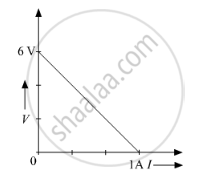
The plot of the variation of potential difference across a combination of three identical cells in series, versus current is shown below. What is the emf and internal resistance of each cell ?
पाठ: [3] Current Electricity
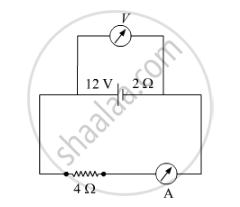
A battery of emf 12 V and internal resistance 2 Ω is connected to a 4 Ω resistor as shown in the figure.
(a) Show that a voltmeter when placed across the cell and across the resistor, in turn, gives the same reading.
(b) To record the voltage and the current in the circuit, why is voltmeter placed in parallel and ammeter in series in the circuit?
पाठ: [3] Current Electricity
What is its relation with relaxation time?
पाठ: [3] Current Electricity
Two identical cells of emf 1.5 V each joined in parallel, supply energy to an external circuit consisting of two resistances of 7 Ω each joined in parallel. A very high resistance voltmeter reads the terminal voltage of cells to be 1.4 V. Calculate the internal resistance of each cell.
पाठ: [3] Current Electricity
Estimate the average drift speed of conduction electrons in a copper wire of cross-sectional area 2.5 × 10⁻⁷ m2 carrying a current of 1.8 A. Assume the density of conduction electrons to be 9 × 1028 m−3.
पाठ: [3] Current Electricity
Estimate the average drift speed of conduction electrons in a copper wire of cross-sectional area 1.0 × 10⁻⁷ m2 carrying a current of 1.5 A. Assume the density of conduction electrons to be 9 × 1028 m−3
पाठ: [3] Current Electricity
Estimate the average drift speed of conduction electrons in a copper wire of cross-sectional area 2·5 × 10−7 m2 carrying a current of 2·7 A. Assume the density of conduction electrons to be 9 × 1028 m−3
पाठ: [3] Current Electricity
A heating element using nichrome connected to a 230 V supply draws an initial current of 3.2 A which settles after a few seconds to a steady value of 2.8 A. What is the steady temperature of the heating element if the room temperature is 27.0°C? The temperature coefficient of resistance of nichrome averaged over the temperature range involved is 1.70 × 10⁻⁴ °C−1.
पाठ: [3] Current Electricity
In a potentiometer arrangement, a cell of emf 1.25 V gives a balance point at 35.0 cm length of the wire. If the cell is replaced by another cell and the balance point shifts to 63.0 cm, what is the emf of the second cell?
पाठ: [3] Current Electricity
How does drift velocity of electrons in a metallic conductor vary with increase in temperature? Explain.
पाठ: [3] Current Electricity
Plot a graph showing variation of voltage vs the current drawn from the cell. How can one get information from this plot about the emf of the cell and its internal resistance?
पाठ: [3] Current Electricity
State Kirchhoff's rules and explain on what basis they are justified.
पाठ: [3] Current Electricity
Given the resistances of 1 Ω, 2 Ω, 3 Ω, how will be combine them to get an equivalent resistance of (11/3) Ω?
पाठ: [3] Current Electricity
Given the resistances of 1 Ω, 2 Ω, 3 Ω, how will be combine them to get an equivalent resistance of (11/5) Ω?
पाठ: [3] Current Electricity
Show variation of resistivity of Si with temperature in a graph ?
पाठ: [3] Current Electricity
A potentiometer wire of length 1.0 m has a resistance of 15 Ω. It is connected to a 5 V battery in series with a resistance of 5 Ω. Determine the emf of the primary cell which gives a balance point at 60 cm.
