Please select a subject first
Advertisements
Advertisements
Two monochromatic rays of light are incident normally on the face AB of an isosceles right-angled prism ABC. The refractive indices of the glass prism for the two rays '1' and '2' are respectively 1.35 and 1.45. Trace the path of these rays after entering the prism.
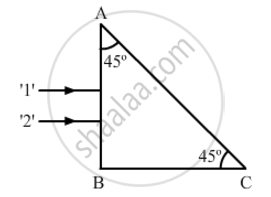
Concept: Refraction of Monochromatic Light
Using the phenomenon of polarisation, show how the transverse nature of light can be demonstrated.
Concept: Polarisation
Two polaroids P1 and P2 are placed with their pass axes perpendicular to each other. An unpolarised light of intensity I0 is incident on P1. A third polaroid P3 is kept in between P1 and P2 such that its pass axis makes an angle of 30° with that of P1. Determine the intensity of light transmitted through P1, P2 and P3
Concept: Polarisation
Show, via a suitable diagram, how unpolarised light can be polarised by reflection.
Concept: Polarisation
Monochromatic light of wavelength 589 nm is incident from air on a water surface. What are the wavelength, frequency and speed of (a) reflected and (b) refracted light? Refractive index of water is 1.33.
Concept: Introduction of Wave Optics
Consider a plane wave front incident on a thin convex lens. Draw a proper diagram to show how the incident wave front traverses through the lens and after refraction focusses on the focal point of the lens, giving the shape of the emergent wave front.
Concept: Huygens' Principle
Draw a graph showing the variation of intensity (I) of polarised light transmitted by an analyzer with the angle (θ) between polariser and analyzer.
Concept: Plane Polarised Light
What is the value of refractive index of a medium of polarising angle 60°?
Concept: Polarisation
Find the intensity at a point on a screen in Young's double slit experiment where the interfering waves have a path difference of (i) λ/6, and (ii) λ/2.
Concept: Interference of Light Waves and Young’s Experiment
Draw the intensity distribution for the fringes produced in interference ?
Concept: Coherent and Incoherent Sources and Sustained Interference of Light
Draw the intensity distribution for the diffraction bands produced due to single slit ?
Concept: Fraunhofer Diffraction Due to a Single Slit
Distinguish between polarized and unpolarized light. Does the intensity of polarized light emitted by a polaroid depend on its orientation? Explain briefly.
The vibration in a beam of polarized light make an angle of 60° with the axis of the polaroid sheet. What percentage of light is transmitted through the sheet?
Concept: Plane Polarised Light
State the essential conditions for diffraction of light ?
Concept: Refraction of Monochromatic Light
(i) State the essential conditions for diffraction of light.
(ii) Explain diffraction of light due to a narrow single slit and the formation of pattern of fringes on the screen.
(iii) Find the relation for width of central maximum in terms of wavelength 'λ', width of slit 'a', and separation between slit and screen 'D'.
(iv) If the width of the slit is made double the original width, how does it affect the size and intensity of the central band?
Concept: Diffraction of Light >> Seeing the Single Slit Diffraction Pattern
Draw a labelled schematic ray diagram of astronomical telescope in normal adjustment.
Concept: Diffraction of Light >> Resolving Power of Microscope and Astronomical Telescope
Which two aberrations do objectives of refracting telescope suffer from? How are these overcome in reflecting telescope?
Concept: Diffraction of Light >> Resolving Power of Microscope and Astronomical Telescope
How does the resolving power of a telescope change on increasing the aperture of the objective lens? Justify your answer.
Concept: Diffraction of Light >> Resolving Power of Microscope and Astronomical Telescope
How does the refractive index of a transparent medium depend on the wavelength of incident light used ?
Concept: Reflection and Refraction of Plane Wave at Plane Surface Using Huygens' Principle >> Refraction at a Rarer Medium
Why cannot two independent monochromatic sources produce sustained interference pattern?
Deduce, with the help of Young's arrangement to produce interference pattern, an expression for the fringe width.
Concept: Diffraction of Light >> Seeing the Single Slit Diffraction Pattern
Monochromatic light of frequency 5.0 × 10¹⁴ Hz is produced by a laser. The power emitted is 3.0 × 10⁻³ W. Estimate the number of photons emitted per second on an average by the source ?
Concept: Refraction of Monochromatic Light
