मराठी

Science (English Medium) इयत्ता १२ - CBSE Important Questions for Biology

Advertisements
[object Object]
[object Object]
विषय
मुख्य विषय
अध्याय
Advertisements
Advertisements
Biology
< prev  201 to 220 of 569  next > 

State the relation between gross and net primary productivity.

Appears in 2 question papers
Chapter: [12] Ecosystem
Concept: Productivity

The following graph shows the species-area relationship. Answer the following questions as directed.
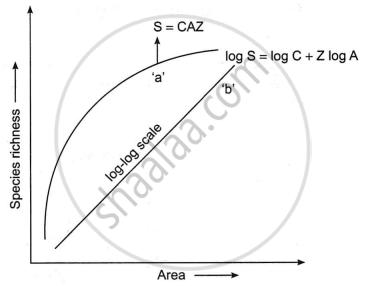
(a) Name the naturalist who studied the kind of relationship shown in the graph. Write the observations made by him.

(b) Write the situations as discovered by the ecologists when the value of ‘Z’
(Slope of the line) lies between:

  1. 0.1 and 0.2
  2. 0.6 and 1.2

What does ‘Z’ stand for?

(c) When would the slope of the line ‘b’ become steeper?

Appears in 2 question papers
Chapter: [13] Biodiversity and Its Conservation
Concept: Patterns of Biodiversity

Answer the following question:
Substantiate with the help of one example that in an ecosystem mutualists
(i) tend to co-evolve and
(ii) are also one of the major causes of biodiversity loss.

Appears in 2 question papers
Chapter: [13] Biodiversity and Its Conservation
Concept: Loss of Biodiversity

Given below is an equation describing the Species-Area relationship between species richness and area for a wide variety of taxa as angiosperm plants, birds, bats etc. S = CAz

  1. Give a graphical representation of the given equation showing Species-Area relationship.
  2. What does 'S' represent in the given equation?
  3. What is the value of 'Z' (regression coefficient) for frugivorous birds and mammals in the tropical forests of different continents?
Appears in 2 question papers
Chapter: [13] Biodiversity and Its Conservation
Concept: Patterns of Biodiversity

Given below is a 'pie chart' representing the global biodiversity:

Proportionate number of species of major taxa.

  1. Identify (X) and (Y) in the given 'pie chart'.
  2. "Extinction of species across taxa are not random." Which group amongst the vertebrates is more vulnerable to extinction?
  3. Give one example of each of the recent extinctions of species in Russia, Mauritius and Australia.
Appears in 2 question papers
Chapter: [13] Biodiversity and Its Conservation
Concept: Biodiversity >> Species on Earth and Species in India

Write the inference drawn by Alexander von Humboldt after his extensive explorations of South American jungle.

Appears in 2 question papers
Chapter: [13] Biodiversity and Its Conservation
Concept: Patterns of Biodiversity

Study the graph given below:
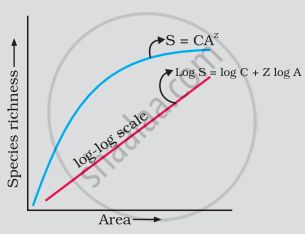
As per Alexander von Humboldt, what do the symbols S, A, Z and C in the graph stand for, in respect of a species and area relationship?

Appears in 2 question papers
Chapter: [13] Biodiversity and Its Conservation
Concept: Patterns of Biodiversity

"Biodiversity plays a major role in many ecosystem services that nature provides."

Describe any two broadly utilitarian arguments to justify the given statement.

Appears in 2 question papers
Chapter: [13] Biodiversity and Its Conservation
Concept: Conservation of Biodiversity

"Biodiversity plays a major role in many ecosystem services that nature provides."

State one ethical reason for conserving biodiversity.

Appears in 2 question papers
Chapter: [13] Biodiversity and Its Conservation
Concept: Conservation of Biodiversity

As a senior biology student you have been asked to demonstrate to the students of secondary level in your school, the procedure(s) that shall ensure cross-pollination in a hermaphrodite flower. List the different steps that you would suggest and provide reasons for each one of them.

Appears in 1 question paper
Chapter: [1] Sexual Reproduction in Flowering Plants
Concept: Pollination

Why do moss plants produce very large number of male gametes? Provide one reason. What are these gametes called?

Appears in 1 question paper
Chapter: [1] Sexual Reproduction in Flowering Plants
Concept: Pollination

Geitonogamous flowering plants are genetically autogamous but functionally cross-pollinated. Justify.

Appears in 1 question paper
Chapter: [1] Sexual Reproduction in Flowering Plants
Concept: Pollination

Describe the characteristic features of wind pollinated flowers.

Appears in 1 question paper
Chapter: [1] Sexual Reproduction in Flowering Plants
Concept: Pollination

Some organisms suspend their metabolic activities to survive in unfavourable conditions. Explain with the help of any four examples.

Appears in 1 question paper
Chapter: [1] Sexual Reproduction in Flowering Plants
Concept: Endosperm

Why are some seeds referred to as apomictic seeds?

Appears in 1 question paper
Chapter: [1] Sexual Reproduction in Flowering Plants
Concept: Polyembryony

Angiosperms bearing unisexual flowers are said to be either monoecious or dioecious. Explain with the help of one example each.

Appears in 1 question paper
Chapter: [1] Sexual Reproduction in Flowering Plants
Concept: Endosperm

A flower of tomato plant following the process of sexual reproduction produces 240 viable seeds.

Answer the following questions giving reasons :

(a) What is the minimum number of pollen grains that must have been involved in the pollination of its pistil?

(b) What would have been the minimum number of ovules present in the ovary?

(c) How many megaspore mother cells were involved?

(d) What is the minimum number of microspore mother cells involved in the above case?

(e) How many male gametes were involved in this case?

Appears in 1 question paper
Chapter: [1] Sexual Reproduction in Flowering Plants
Concept: Pollination

A non biology person is quite shocked to know that apple is a false fruit, mango is a true fruit and banana is a seedless fruit. As a biology student how would you satisfy this person?

Appears in 1 question paper
Chapter: [1] Sexual Reproduction in Flowering Plants
Concept: Endosperm

Describe the development of endosperm after double fertilisation in an angiosperm.

Appears in 1 question paper
Chapter: [1] Sexual Reproduction in Flowering Plants
Concept: Endosperm

A flower of tomato plant following the process of sexual reproduction produces 200 viable seeds.

Answer the following questions giving reasons :

(a) What would have been the minimum number of ovules present in pre-pollinated pistil ?

(b) How many microscope mother cells would minimally be required to produce requisite number of pollen grains ?

(c) How many pollen grains must have minimally pollinated the carple ?

(d) How many male gametes would have used to produce these 200 viable seeds ?

(e) How many megaspore mother cells were required in this process ?


Appears in 1 question paper
Chapter: [1] Sexual Reproduction in Flowering Plants
Concept: Pollination
< prev  201 to 220 of 569  next > 
Advertisements
Advertisements
CBSE Science (English Medium) इयत्ता १२ Important Questions
Important Questions for CBSE Science (English Medium) इयत्ता १२ Biology
Important Questions for CBSE Science (English Medium) इयत्ता १२ Chemistry
Important Questions for CBSE Science (English Medium) इयत्ता १२ Computer Science (C++)
Important Questions for CBSE Science (English Medium) इयत्ता १२ Computer Science (Python)
Important Questions for CBSE Science (English Medium) इयत्ता १२ English Core
Important Questions for CBSE Science (English Medium) इयत्ता १२ English Elective - NCERT
Important Questions for CBSE Science (English Medium) इयत्ता १२ Entrepreneurship
Important Questions for CBSE Science (English Medium) इयत्ता १२ Geography
Important Questions for CBSE Science (English Medium) इयत्ता १२ Hindi (Core)
Important Questions for CBSE Science (English Medium) इयत्ता १२ Hindi (Elective)
Important Questions for CBSE Science (English Medium) इयत्ता १२ History
Important Questions for CBSE Science (English Medium) इयत्ता १२ Informatics Practices
Important Questions for CBSE Science (English Medium) इयत्ता १२ Mathematics
Important Questions for CBSE Science (English Medium) इयत्ता १२ Physical Education
Important Questions for CBSE Science (English Medium) इयत्ता १२ Physics
Important Questions for CBSE Science (English Medium) इयत्ता १२ Political Science
Important Questions for CBSE Science (English Medium) इयत्ता १२ Psychology
Important Questions for CBSE Science (English Medium) इयत्ता १२ Sanskrit (Core)
Important Questions for CBSE Science (English Medium) इयत्ता १२ Sociology
Share
Notifications

Englishहिंदीमराठी


      Forgot password?
Use app×