Commerce (English Medium)
Science (English Medium)
Arts (English Medium)
Academic Year: 2019-2020
Date & Time: 6th March 2020, 10:30 am
Duration: 3h
Advertisements
After the collapse of communism in the Soviet Union, why was the process of transition called a painful one?
Chapter:
“Soviet Union represented the ideology of ______ during the Cold War.”
Chapter:
Which one of the following was NOT an outcome of ‘Shock Therapy’?
The old system of social welfare got destroyed.
Industries were put up for sale to the private sector.
The value of the Russian currency, the ‘Ruble’, rose dramatically.
Russia started to import food grains.
Chapter:
The U.N. was founded as a successor to which international organization?
Chapter:
Even after the U.N. refused to give its mandate to the invasion, President Clinton ordered “Operation ______.”
Chapter:
As permanent members of the U.N. Security Council, which special power do Britain and France enjoy?
Chapter:
Which one of the following is a right cause of globalisation?
The U.S. people initiated globalisation.
Technology led to globalisation.
The Cold War led to globalisation.
The policy of Non-alignment led to globalisation.
Chapter:
Correct and rewrite the following sentence in your answer book:
Global commons are those resources which are owned by big countries only.
Chapter:
Why was the United Front Government of 1996 similar to the National Front Government of 1989?
Chapter:
What was the ‘two-nation theory’ as advanced by the Muslim League?
Chapter:
Advertisements
Which one of the following was not a part of the early phase of India’s development policy?
Planning
Self sufficiency
Privatisation
Social and economic justice
Chapter:
When and why did the Communist Party of India go through a major split?
Chapter:
Is there any mention of ‘International Peace and Security’ in the Constitution of India? If yes, then where and under which Article of the Constitution has it been mentioned?
Chapter:
Show with the help of any one example when India refrained to condemn the U.S.S.R. during the Cold War period.
Chapter:
Explain the meaning of ‘Congress Syndicate’ as a part of the Congress Party.
Chapter:
Analyse the reason for preponing the fifth General Elections in India from 1972 to 1971.
Chapter:
Identify the Prime Minister of India from amongst the following who headed the first Coalition Government in India.
Atal Bihari Vajpayee
V.P. Singh
Morarji Desai
H.D. Deva Gowda
Chapter:
Give any one suitable argument to justify the Chipko Movement.
Chapter:
Distinguish between a ‘Unipolar World’ and a ‘Multipolar World’.
Chapter:
Name any four organs of United Nations.
Chapter: [4] International Organizations
Show with the help of any two examples that Indira Gandhi had a leaning towards the ideology of socialism.
Chapter:
Assess India’s relations with China from a friendly note after freedom to the Chinese invasion in 1962.
Chapter:
State any four policies and programmes of Bharatiya Jana Sangh.
Chapter:
Advertisements
What role did India play to help Sri Lanka in resolving the ethnic conflict?
Chapter:
Explain any two major policy decisions made by the Chinese government to open and develop its economy.
Chapter: [2] Contemporary Centres of Power
Analyse any two major developments after 1980 that led to a cycle of violence in Punjab.
Chapter:
Study the cartoon given below carefully and answer the questions that follow:
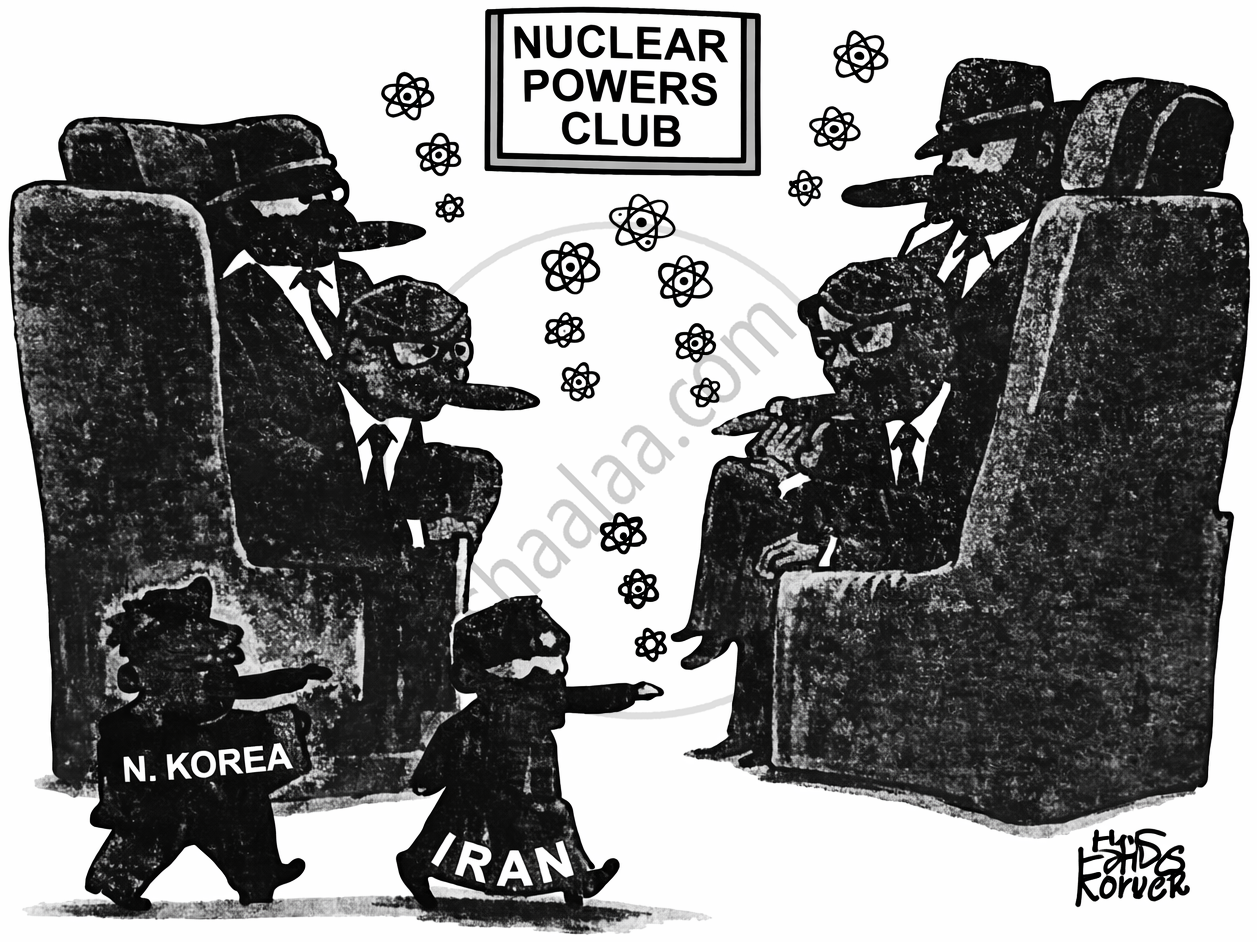
- How do the big powers react when new countries claim nuclear status?
- On what basis can we say that some countries can be trusted with nuclear weapons while others can’t be?
- Besides the big powers, N. Korea and Iran, name any other two countries which possess nuclear weapons.
Chapter:
Read the passage given below carefully and answer the following questions:
| During the Cold War years, India found itself on the opposite side of the divide from the U.S. India’s closest friendship during those years was with the Soviet Union. After the collapse of the Soviet Union, India suddenly found itself friendless in an increasingly hostile international environment. However, these were also the years when India decided to liberalise its economy and integrate it with the global economy. This policy and India’s impressive economic growth rates in recent years have made the country an attractive economic partner for a number of countries, including the U.S. |
- Which were the years of the Cold War period?
- Explain any two factors responsible for the close relationship between India and the Soviet Union.
- Give any two examples of economic liberalization that have benefited India.
Chapter:
Read the passage given below carefully and answer the questions that follow:
| The defeat of the official Congress candidate formalized the split in the party. The Congress President expelled the Prime Minister from the party; she claimed that her group was the real Congress. By November 1969, the Congress group led by the ‘syndicate’ came to be referred to as the Congress (Organization), and the group led by Indira Gandhi came to be called the Congress (Requisitionists). These two parties were also described as Old Congress and New Congress. Indira Gandhi projected the split as an ideological divide. |
- The passage is related to which election in India?
- Who was the official Congress candidate in that election?
- Why did then Congress President expelled the Prime Minister from the party?
- According to Indira Gandhi, how was the split in the Congress an ideological divide?
Chapter:
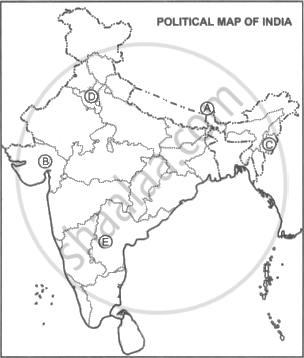
In the given outline political map of India, five states have been marked as A, B, C, D, and E. Identify these states on the basis of the information given below and write their correct names in your answer book along with the respective serial number of the information used and the concerned alphabets in the map as per the following format.
| Serial No. of the information used | Concerned Alphabet |
Name of the State |
|
| (i) | |||
| (ii) | |||
| (iii) | |||
| (iv) | |||
| (v) |
- The Princely State which resisted its merger with Union of India.
- The state, which was carved out of Punjab in 1966.
- The state which was created in December 1952.
- The 22nd State of the Indian Union.
- The state that was created in 1960.
Chapter:
“The Cold War promoted an arms race as well as arms control.” Support the statement with any three suitable arguments.
Chapter:
“In the present unipolar world, in spite of strong friendly bonds with Russia, India should change its foreign policy and improve its relations with the U.S.A.” Support the statement with any three suitable arguments.
Chapter:
Explain the meaning of ‘Common but differentiated responsibilities’ in the light of the ‘Earth Summit’ and the United Nations Framework Convention on Climate Change 1992.
Chapter:
Explain any six effects of globalisation on the people all over the world.
Chapter:
Describe any four major demands made by the Bhartiya Kisan Union in 1988.
Chapter:
Highlight any two characteristics of the Bharatiya Kisan Union agitation.
Chapter:
Describe any four major political developments that India witnessed between the period 1989 to 1999.
Chapter:
Other Solutions
Submit Question Paper
Help us maintain new question papers on Shaalaa.com, so we can continue to help studentsonly jpg, png and pdf files
CBSE previous year question papers Class 12 Political Science with solutions 2019 - 2020
Previous year Question paper for CBSE Class 12 Political Science-2020 is solved by experts. Solved question papers gives you the chance to check yourself after your mock test.
By referring the question paper Solutions for Political Science, you can scale your preparation level and work on your weak areas. It will also help the candidates in developing the time-management skills. Practice makes perfect, and there is no better way to practice than to attempt previous year question paper solutions of CBSE Class 12.
How CBSE Class 12 Question Paper solutions Help Students ?
• Question paper solutions for Political Science will helps students to prepare for exam.
• Question paper with answer will boost students confidence in exam time and also give you an idea About the important questions and topics to be prepared for the board exam.
• For finding solution of question papers no need to refer so multiple sources like textbook or guides.
