Topics
Contemporary World Politics
Challenges of Nation-building
- Nehru's Approach to Nation-building
- Legacy of Partition - Challenge of 'Refugee' Resettlement, the Kashmir Problem
- Organisation and Reorganization of States
- Political Conflicts Overlanguage
- Challenges for the New Nation
- Partition: Displacement and Rehabilitation
- Integration of Princely States
- Overview of Challenges of Nation-building
The End of Bipolarity
- Introduction to the End of Bipolarity
- What Was the Soviet System?
- Gorbachev and Disintegration
- Why Did the Soviet Union Disintegrate?
- Consequences of Disintegration
- Shock Therapy in Post-communist Regimes
- Shock Therapy and Its Consequenes
- Tensions and Conflicts
- India and Post-communist Countries
- New Entities in World Politics: Russia, Balkan States and Central Asian States
- Introduction of Democratic Politics and Capitalism in Post-communist Regimes
- Overview of The End of Bipolarity
Cold War Era
- Introduction to the Cold War Era
- The Berlin Blockade (1948-1949)
- Cold War (1945-1991)
- Emergence of Two Power Blocs After the Second World War
- Arenas of the Cold War
- Challenges to Bipolarity
- New International Economic Order
- India and the Cold War
- Disintegration of the Soviet Union and Its Impact Or Consequences on the World Order
US Hegemony in World Politics
- Introduction of US Hegemony in World Politics
- Ayesha, Jabu and Andrei
- Beginning of the ‘New World Order’
- The Clinton Years
- 9/11 and the ‘Global War on Terror’
- The Iraq Invasion
- Hegemony
- Constraints on American Power
- India's Relationship with the Us
- How Can Hegemony Be Overcome?
- Growth of Unilateralism - Afghanistan, First Gulf War, Response to 9/11 and Attack on Iraq
- Dominance and Challenge to the Us in Economy and Ideology
Contemporary Centres of Power
- Introduction to Alternative Centres of Power
- European Union
- Association of South East Asian Nations (ASEAN)
- The Rise of the Chinese Economy
- India-China Relations
- Overview of Contemporary Centres of Power
Era of One-party Dominance
- Introduction of Era of One-party Dominance
- Congress Dominance in the First Three General Elections
- Nature of Congress Dominance at the National Level
- Uneven Dominance at the State Level
- Coalitional Nature of Congress
- Emergence of Opposition Parties
- Challenge of Building Democracy
- Overview of Era of One-party Dominance
Politics in India since Independence
Rise of Popular Movements
- Farmer's Movements
- Womens’ Movement in India
- Environment and Development - Affected People'S Movements
- Implementation of Mandal Commission Report and Its Aftermath
- Nature of Popular Movements
- Dalit Panthers
- Bharatiya Kisan Union
- Anti Arrack Movement
- Narmada Bachao Aandolan
- Lesson from Popular Movements
Politics of Planned Development
- 12th Five Year Plan (2012-2017)
- Expansion of State Sector and the Rise of New Economic Interests
- Famine and Suspension of Five Year Plans
- Green Revolution and Its Political Fallouts
- Introduction of Politics of Planned Development
- The Early Initiatives
- Key Controversies
- Major Outcome
- Overview of Politics of Planned Development
Contemporary South Asia
- Introduction to Contemporary South Asia
- What is South Asia?
- The Military and Democracy in Pakistan
- Democracy in Bangladesh
- Monarchy and Democracy in Nepal
- Ethnic Conflict and Democracy in Sri Lanka
- India-Pakistan Conflicts
- India's Relations with Its Neighbours
- Peace and Cooperation
- Impact of Economic Globalization on the Region
- Conflicts and Efforts for Peace in South Asia
- Overview of Contemporary South Asia
India's External Relations
- Nehru's Foreign Policy
- Sino-Indian War
- Pakistan (1948–49, 1965, 1971)
- India'S Nuclear Programme
- Shifting Alliance in World Politics
- International Context
- The Policy of Non-alignment
- Peace and Conflict with China
- Wars and Peace with Pakistan
- India's Nuclear Policy
- Overview of India's External Relations
International Organizations
- Introduction to International Organisations
- Why International Organisations?
- Evolution of the UN
- Reform of the UN After the Cold War
- Reform of Structures and Processes
- Jurisdiction of the UN
- India and the UN Reforms
- The UN in a Unipolar World
- Restructuring and the Future of the UN
- India'S Position in the Restructured UN
- Rise of New International Actors - New International Economic Organisations, Ngos
- How Democratic and Accountable Are the New Institutions of Global Governance
- Overview of International Organizations
Security in Contemporary World
- Introduction to Security in the Contemporary World
- What is Security?
- Traditional Notions: External
- Traditional Security and Cooperation
- Non-traditional Notions
- New Sources of Threats
- Cooperative Security
- India’s Security Strategy
- Traditional Concerns of Security and Politics of Disarmament
- Non-traditional Or Human Security - Global Poverty, Health and Education
- Issues of Human Rights and Migration
- Overview of Security in Contemporary World
Challenges to and Restoration of the Congress System
- Political Succession After Nehru
- Non-congressism and Electoral Upset of 1967
- Congress Split and Reconstitution
- Congress Victory in 1971 Elections
- Politics of Garibi Hatao
- Fourth General Elections, 1967
- Split in the Congress
- The 1971 Election and Restoration of Congress
- Overview of Challenges to the Congress System
Crisis of the Democratic Order
- Search for Committed Bureaucracy and Judiciary
- Navnirman Movement in Gujarat and the Bihar Movement
- Emergency - Context, Constitutional and Extra-constitutional Dimensions, Resistance to Emergency
- 1977 Elections and the Formation of Janata Party
- Rise of Civil Liberties Organisations
- Background to Emergency
- Declaration of Emergency
- Controversies Regarding Emergency
- Politics After Emergency
- Overview of Crisis of the Democratic Order
Environment and Natural Resources
- Introduction to Environment and Natural Resources
- Environmental Concerns in Global Politics
- The Protection of Global Commons
- Common but Differentiated Responsibilities
- Common Property Resources
- India's Stand on Environmental Issues
- Environment Movements: One Or Many?
- Resource Geopolitics
- The Indigenous Peoples and Their Rights
- Rights of Indigenous People
- Overview of Environment and Natural Resources
Globalisation
- Political Consequences
- Economic Consequences
- Cultural Consequences
- India and Resistance to Globalisation
- Economic, Cultural and Political Manifestations
- Debates on the Nature of Consequences of Globalisation
- Anti-globalisation Movements
- India as an Arena of Globalization and Struggle Against It
- Name Or Description
- Overview of Globalisation
- Opportunities and Threats of Globalization
Regional Aspirations
- Rise of Regional Parties
- Punjab Crisis and the Anti Sikh Riots of 1984
- The Kashmir Situation
- Challenges and Responses in the North East
- Region and the Nation
- Accommodation and National Integration
- Dravidian Movement
- Overview of Regional Aspirations
Recent Developments in Indian Politics
- Participatory Upsurge in 1990s
- Rise of the JD and the BJP
- Increasing Role of Regional Parties and Coalition Politics
- Coalition Governments - NDA (1998 - 2004) UPA (2004 - 2014) NDA (2014 Onwards)
- Context of the 1990s
- Era of Coalitions
- Political Rise of Other Backward Classes
- Communalism, Secularism, Democracy
- Emergence of a New Consensus
- Overview of Recent Developments in Indian Politics
- Introduction
- Core Objective
- Targets of 12th Five-Year Plan
- Economic Growth Targets
- Poverty Reduction and Employment
- Education Transformation
- Health and Demographics
- Infrastructure Development
- Environmental Sustainability
- Service Delivery Revolution
- Key Point Summary
Introduction
India's 12th Five-Year Plan was the country's final comprehensive planning document, focusing on "Faster, Sustainable and More Inclusive Growth". Launched during a global economic slowdown, it aimed to achieve balanced development across all sectors.
Core Objective
The plan prioritised three key dimensions:
- Faster Growth: Accelerated economic development
- Sustainable Growth: Environmentally conscious development
- Inclusive Growth: Benefits reaching all sections of society
Targets of the 12th Five-Year Plan
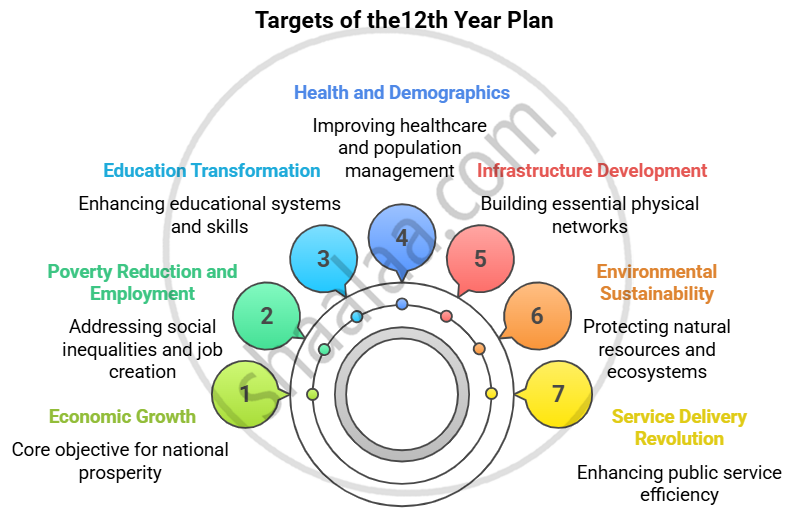
Economic Growth Targets
| Sector | Target Growth Rate | Focus Areas |
|---|---|---|
| Real GDP | 8.0% annually | Overall economic expansion |
| Agriculture | 4.0% | Food security and rural income |
| Manufacturing | 10.0% | Industrial development and employment |
| State Performance | Higher than 11th Plan | Regional balanced growth |
Poverty Reduction and Employment
- Poverty Reduction: Decrease head-count ratio by 10 percentage points
- Employment Generation: Create 5 crore (50 million) new non-farm jobs
- Skill Development: Provide skill certification to equivalent numbers
Education Transformation
- Mean Schooling Years: Increase to 7 years from existing levels
- Higher Education: Add 20 lakh seats for each age cohort
- Gender Equality: Eliminate enrollment gaps between boys and girls and different social groups
Health and Demographics
- Total Fertility Rate: Reduce to 2.1 (replacement level)
- Child Malnutrition: Cut undernutrition in 0-3 age group to half of NFHS-3 levels
- Maternal and Infant Mortality: Significant reductions targeted
Infrastructure Development
| Infrastructure Area | Target | Significance |
|---|---|---|
| GDP Investment | 9% of GDP | Massive infrastructure push |
| Rural Roads | All-weather connectivity to all villages | Rural accessibility |
| Electricity | 100% village electrification | Energy access |
| Telecommunications | 70% rural tele-density | Digital connectivity |
| Irrigation | 103 million hectares (from 90 million) | Agricultural productivity |
Environmental Sustainability
- Green Cover: Increase by 1 million hectares annually
- Renewable Energy: Add 30,000 MW capacity
- Emission Intensity: Reduce by 20-25% from 2005 levels by 2020
Service Delivery Revolution
- Banking Access: Extend to 90% of Indian households
- Direct Benefit Transfer: Shift subsidies to Aadhaar-linked cash transfers
Key Point Summary
Vision Achieved: Sustainable development framework established
Economic Targets: Mixed results due to global challenges
Social Progress: Significant improvements in education, health access
Infrastructure: Major connectivity and energy access gains
Environmental: Renewable energy sector transformation began
Test Yourself
Shaalaa.com | Five Year Plans
Related QuestionsVIEW ALL [11]
Identify the correct of pairs from the given options:
| 'A' | 'B' | ||
| 1) | Economic Planning | a) | Selection by Prime Minister |
| 2) | Twelfth Five Year Plan | b) | Think Tank group of Indian Government |
| 3) | NITI Aayog | c) | Fast and sustainable growth |
| 4) | NITI Aayog Vice-Chairperson | d) | Time bound programme |
Identify the correct of pairs from the given options:
| 'A' | 'B' |
| 1) Economic Planning | a) Selection by Prime Minister |
| 2) Twelfth Five Year Plan | b) Think Tank group of Indian Government |
| 3) NITI Aayog | c) Fast and sustainable growth |
| 4) NITI Aayog Vice-Chairperson | d) Time bound programme |
Identify the correct pairs from the given option.
| 'A' | 'B' | ||
| 1) | Economic planning | a) | Selection by prime Minister |
| 2) | Twelfth Five year plan | b) | Think tank group of the Indian government |
| 3) | NITI Aayog | c) | Fast and sustainable growth |
| 4) | NITI Aayog Vice-Chairperson | d) | Time bound programme |
Identify the correct of pairs from the given options:
| 'A' | 'B' | ||
| 1) | Economic planning | a) | Selection by Prime Minister |
| 2) | Twelfth Five Year Plan | b) | Think Tank group of Indian Government |
| 3) | NITI Aayog | c) | Fast and sustainable growth |
| 4) | NITI Aayog Vice-Chairperson | d) | Time-bound programme |
Identify the correct of pairs from the given options:
| Group 'A' | Group 'B' | ||
| 1) | Economic Planning | a) | Selection by Prime Minister |
| 2) | Twelfth Five Year Plan | b) | Think Tank group of Indian Government |
| 3) | NITI Aayog | c) | Fast and sustainable growth |
| 4) | NITI Aayog Vice-Chairperson | d) | Time bound programme |
Identify the right group of pairs from the given options:
| ‘A’ | ‘B’ |
| 1) Economic Planning | a) Selection by Prime Minister |
| 2) Twelfth Five Year Plan | b) Think Tank group of Indian Government |
| 3) NITI Aayog | c) Fast and sustainable growth |
| 4) NITI Aayog Vice-Chairperson | d) Time bound programme |
