Advertisements
Advertisements
प्रश्न
Why do we add alum to purify water?
Advertisements
उत्तर
River water carries negatively charged colloidal particles of clay and sand; alum \[\ce{(K2SO4Al2(SO4)3 24H2O)}\] is added to river water to coagulate the colloidal particles of clay and sand. Thus, alum helps to purify water.
APPEARS IN
संबंधित प्रश्न
What is the reason for the stability of colloidal sols?
Define the following terms: Associated colloids
Out of MgCl2 and AlCl3, which one is more effective in causing coagulation of negatively charged sol and why?
Define the following term : Brownian movement
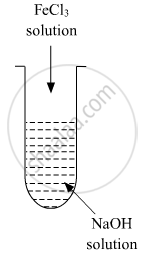
A colloidal sol is prepared by the given method in the figure. What is the charge on hydrated ferric oxide colloidal particles formed in the test tube? How is the solution represented?

A colloidal sol is prepared by the given method in the figure. What is the charge on hydrated ferric oxide colloidal particles formed in the test tube? How is the sol represented?
The values of colligative properties of colloidal solution are of small order in comparison to those shown by true solutions of same concentration because of colloidal particles ______.
What happens when a lyophilic sol is added to a lyophobic sol?
(i) Lyophobic sol is protected.
(ii) Lyophilic sol is protected.
(iii) Film of lyophilic sol is formed over lyophobic sol.
(iv) Film of lyophobic sol is formed over lyophilic sol.
Which phenomenon occurs when an electric field is applied to a colloidal solution and electrophoresis is prevented?
(i) Reverse osmosis takes place.
(ii) Electroosmosis takes place.
(iii) Dispersion medium begins to move.
(iv) Dispersion medium becomes stationary.
How does it become possible to cause artificial rain by spraying silver iodide on the clouds?
What causes brownian motion in colloidal dispersion?
Why does leather get hardened after tanning?
Assertion: An ordinary filter paper impregnated with collodion solution stops the flow of colloidal particles.
Reason: Pore size of the filter paper becomes more than the size of colloidal particle.
Give reason for the following:
Lyophilic colloidal solutions are more stable than lyophobic colloidal solutions.
Which of the following is used for removing change on colloidal solution?
State the Hardy-Schulze rule.
What is electrophoresis?
Which of the following is a correct statement?
In order to cause coagulation of 100 ml Arsenious sulphide sol 111.7 mg of 2 M NaCl solution is used, the coagulation value of NaCl will be ______.
