Advertisements
Advertisements
प्रश्न
Define coagulation.
Advertisements
उत्तर
It is a process of aggregating together the colloidal particles so as to change them into large-sized particles, which ultimately settle as a precipitate.
APPEARS IN
संबंधित प्रश्न
Explain the term Electrophoresis
What happens when an emulsion is centrifuged?
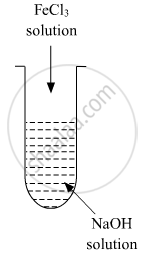
A colloidal sol is prepared by the given method in the figure. What is the charge on hydrated ferric oxide colloidal particles formed in the test tube? How is the solution represented?

A colloidal sol is prepared by the given method in the figure. What is the charge on hydrated ferric oxide colloidal particles formed in the test tube? How is the sol represented?
Which of the following statements are correct?
(i) Mixing two oppositely charged sols neutralises their charges and stabilises the colloid.
(ii) Presence of equal and similar charges on colloidal particles provides stability to the colloids.
(iii) Any amount of dispersed liquid can be added to emulsion without destabilising it.
(iv) Brownian movement stabilises sols.
Match the statement given in Column I with the phenomenon given in Column II.
| Column I | Column II |
| (i) Dispersion medium moves in an electric field | (a) Osmosis |
| (ii) Solvent molecules pass through semi permeable membrane towards solvent side |
(b) Electrophoresis |
| (iii) Movement of charged colloidal particles under the influence of applied electric potential towards oppositely charged electrodes |
(c) Electroosmosis |
| (iv) Solvent molecules pass through semi permeable membranes towards solution side |
(d) Reverse osmosis |
Gold number of protective colloids A, Band Dare 0.50, 0.01 and 0.10 and 0.005. The correct order of their protecting power is
The right option for the statement “Tyndall effect is exhibited by”, is:
State the Hardy-Schulze rule.
What is electrophoresis?
