मराठी

Define the Following Term : Brownian Movement - Chemistry

Advertisements
Advertisements

प्रश्न

Define the following term : Brownian movement

Advertisements

उत्तर

The continuous random zig-zag motion of colloidal particles in the colloidal solution, when observed under an ultramicroscope, is called Brownian movement/motion.

shaalaa.com
  या प्रश्नात किंवा उत्तरात काही त्रुटी आहे का?
2014-2015 (March) Patna Set 2

व्हिडिओ ट्यूटोरियलVIEW ALL [1]

संबंधित प्रश्‍न

Define the following term:

Zeta potential


Give reasons for the following observations:

Brownian movement provides stability to the colloidal solution.


Out of BaCl2 and KCl, which one is more effective in causing coagulation of a negatively charged colloidal Sol? Give reason.


Explain what is observed when an electric current is passed through a colloidal sol?


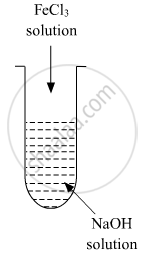
A colloidal sol is prepared by the given method in the figure. What is the charge on hydrated ferric oxide colloidal particles formed in the test tube? How is the sol represented?

The values of colligative properties of colloidal solution are of small order in comparison to those shown by true solutions of same concentration because of colloidal particles ______.


Which phenomenon occurs when an electric field is applied to a colloidal solution and electrophoresis is prevented?

(i) Reverse osmosis takes place.

(ii) Electroosmosis takes place.

(iii) Dispersion medium begins to move.

(iv) Dispersion medium becomes stationary.


How does it become possible to cause artificial rain by spraying silver iodide on the clouds?


What causes brownian motion in colloidal dispersion?


The conditions given below are in the context of observing Tyndall effect in colloidal solutions:

  1. The diameter of the colloidal particles is comparable to the wavelength of light used.
  2. The diameter of the colloidal particles is much smaller than the wavelength of light used.
  3. The diameter of the colloidal particles is much larger than the wavelength of light used.
  4. The refractive indices of the dispersed phase and the dispersion medium are comparable.
  5. The dispersed phase has a very different refractive index from the dispersion medium.

Choose the most appropriate conditions from the options given below:


Share
Notifications

Englishहिंदीमराठी


      Forgot password?
Use app×