Advertisements
Advertisements
प्रश्न
The values of colligative properties of colloidal solution are of small order in comparison to those shown by true solutions of same concentration because of colloidal particles ______.
पर्याय
exhibit enormous surface area.
remain suspended in the dispersion medium.
form lyophilic colloids.
are comparatively less in number.
Advertisements
उत्तर
The values of colligative properties of colloidal solution are of small order in comparison to those shown by true solutions of same concentration because of colloidal particles are comparatively less in number.
Explanation:
Collodial particles are bigger aggregative than the number of particles in a collodial solution. Hence, the values of colligative are of small order as compared to values shown by true solutions at same concencration.
APPEARS IN
संबंधित प्रश्न
What is the reason for the stability of colloidal sols?
Give reasons for the following observations:
Brownian movement provides stability to the colloidal solution.
Out of BaCl2 and KCl, which one is more effective in causing coagulation of a negatively charged colloidal Sol? Give reason.
Give reasons for the following observations: Leather gets hardened after tanning.
What modification can you suggest in the Hardy-Schulze law?
Explain what is observed when a beam of light is passed through a colloidal sol.
Explain what is observed when an electrolyte NaCl is added to hydrated ferric oxide sol.
Answer the following question.
Why are medicines more effective in the colloidal state?
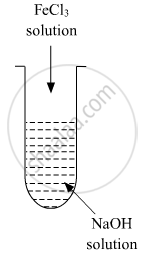
A colloidal sol is prepared by the given method in the figure. What is the charge on hydrated ferric oxide colloidal particles formed in the test tube? How is the solution represented?

A colloidal sol is prepared by the given method in the figure. What is the charge on hydrated ferric oxide colloidal particles formed in the test tube? How is the sol represented?
Which of the following will show Tyndall effect?
What happens when a lyophilic sol is added to a lyophobic sol?
(i) Lyophobic sol is protected.
(ii) Lyophilic sol is protected.
(iii) Film of lyophilic sol is formed over lyophobic sol.
(iv) Film of lyophobic sol is formed over lyophilic sol.
Why do we add alum to purify water?
Give reason for the following:
Lyophilic colloidal solutions are more stable than lyophobic colloidal solutions.
The important factor in the stabilization of a colloidal solution is ______
What is electrophoresis?
In order to cause coagulation of 100 ml Arsenious sulphide sol 111.7 mg of 2 M NaCl solution is used, the coagulation value of NaCl will be ______.
6.84 g Al2(SO4)3 is needed to coagulate 2.5 L of As2S3 sol completely in 2.0 hrs. The coagulation value of Al2 (SO4)3 is ______.
