Advertisements
Advertisements
प्रश्न
Which of the following point defects are shown by AgBr(s) crystals?
- Schottky defect
- Frenkel defect
- Metal excess defect
- Metal deficiency defect
पर्याय
A and B
C and D
A and C
B and D
Advertisements
उत्तर
A and B
Explanation:
AgBr shows both Schottky and Frenkel defects.
In AgBr, both Ag+ and Br ions are absent from the lattice causing Schottky defect. However, Ag+ ions are mobile so they have a tendency to move aside the lattice and trapped in interstitial site, hence causing Frenkel defect.
APPEARS IN
संबंधित प्रश्न
Give reasons : In stoichiometric defects, NaCl exhibits Schottky defect and not Frenkel defect.
What type of defect is shown by NaCl in
stoichiometric defects, and
non-stoichiometric defects?
Answer the following question.
What type of stoichiometric defect is shown by ZnS and why?
Defects in solids can be studied using
Dislocation defect is also known as ____________.
The radius of Cs+ is 169 pm and Cl− is 181 pm. The radius ratio is ____________.
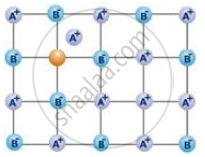
The following diagram shows:
Schottky defect defines imperfection in the lattice structure of ____________.
Which is not correct about the Schottky defects?
Assertion: No compound has both Schottky and Frenkel defects.
Reason: Both defects change the density of the solid.
Assertion: Due to Frenkel defect, there is no effect on the density of the crystalline solid.
Reason: In Frenkel defect, no cation or anion leaves the crystal.
What is the effect of Frenkel defect on the density of ionic solids?
In a Schottky defect ____________.
Cations are present in the interstitial sites in ______.
Which of the following defects is also known as dislocation defect?
Frenkel defect is also known as:
(i) stoichiometric defect
(ii) dislocation defect
(iii) impurity defect
(iv) non-stoichiometric defect
Why is FeO (s) not formed in stoichiometric composition?
Match the defects given in Column I with the statements in given Column II.
| Column I | Column II |
| (i) Simple vacancy defect | (a) shown by non-ionic solids and increases density of the solid. |
| (ii) Simple interstitial defect | (b) shown by ionic solids and decreases density of the solid. |
| (iii) Frenkel defect | (c) shown by non ionic solids and density of the solid decreases. |
| (iv) Schottky defect | (d) shown by ionic solids and density of the solid remains the same. |
