Advertisements
Advertisements
प्रश्न
What is intensity (or) amplitude division?
Advertisements
उत्तर
- If we allow light to pass through a partially silvered mirror (beam splitter), both reflection and refraction take place simultaneously.
- As the two light beams are obtained from the same light source, the two divided light beams will be coherent beams.
- They will be either in-phase or at constant phase differences.
- Instruments like Michelson’s interferometer, FabrayPerrot etalon work on this principle.
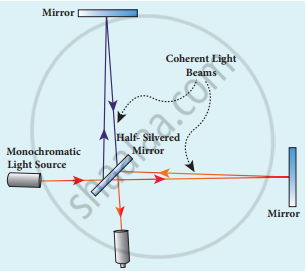
Intensity or amplitude division
APPEARS IN
संबंधित प्रश्न
When a drop of oil is spread on a water surface, it displays beautiful colours in daylight because of ______________ .
A long narrow horizontal slit is paced 1 mm above a horizontal plane mirror. The interference between the light coming directly from the slit and that after reflection is seen on a screen 1.0 m away from the slit. If the mirror reflects only 64% of the light energy falling on it, what will be the ratio of the maximum to the minimum intensity in the interference pattern observed on the screen?
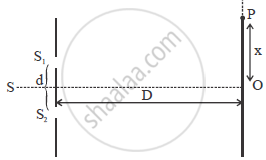
The intensity at the central maximum (O) in a Young’s double slit experimental set-up shown in the figure is IO. If the distance OP equals one-third of the fringe width of the pattern, show that the intensity at point P, would equal `(I_0)/4`.
How does wavefront division provide coherent sources?
Explain Young’s double-slit experimental setup and obtain the equation for path difference.
Discuss the interference in thin films and obtain the equations for constructive and destructive interference for transmitted and reflected light.
Light of wavelength 600 nm that falls on a pair of slits producing interference pattern on a screen in which the bright fringes are separated by 7.2 mm. What must be the wavelength of another light which produces bright fringes separated by 8.1 mm with the same apparatus?
A wire of length 'L' and area of cross-section · A' is made of material of Young's modulus 'Y'. It is stretched by an amount 'x'. The work done in stretching the wire is ______.
In a Young's double-slit experiment, the intensity at a point where the path difference is `lambda/3` (`lambda` being the wavelength of the light used) is I. If I0 denotes the maximum intensity, then `"I"/"I"_0` is equal to ______.
In a biprism experiment, red light of wavelength 6500 Å was used. It was then replaced by green light of wavelength 5200 Å. The value of n for which (n + 1)th green bright band would coincide with nth red bright band for the same setting is ______.
In a biprism experiment, the slit separation is 1 mm. Using monochromatic light of wavelength 5000 Å, an interference pattern is obtained on the screen. Where should the screen be moved? so that the change in fringe width is 12.5 x 10⁵ m?
In the biprism experiment, a source of monochromatic light is used for a certain distance between slit and eyepiece. When the distance between two virtual sources is changed from dA to dB, then the fringe width is changed from ZA to ZB. The ratio ZA to ZB is ______
If we have two coherent sources S1 and S2 vibrating in phase, then for an arbitrary point P constructive interference is observed whenever the path difference is ______.
How will the interference pattern of Young's double slit change if one of the two slits is covered by a paper which transmits only half of the light intensity?
Show graphically the intensity distribution in a single slit diffraction pattern.
Interference fringes are produced on a screen by using two light sources of intensities I and 9I. The phase difference between the beams is `pi/2` at point P and π at point Q on the screen. The difference between the resultant intensities at point P and Q is ______.
The path difference between two interference light waves meeting at a point on the screen is `(87/2)lambda`. The band obtained at that point is ______.
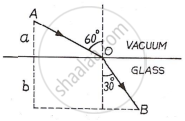
A ray of light AO in a vacuum is incident on a glass slab at an angle of 60° and refracted at an angle of 30° along OB as shown in the figure. The optical path length of the light ray from A to B is ______.
Describe Young's double-slit interference experiment.
