Advertisements
Advertisements
प्रश्न
Answer in brief:
In Young's double-slit experiment what will we observe on the screen when white light is incident on the slits but one slit is covered with a red filter and the other with a violet filter? Give reasons for your answer.
Advertisements
उत्तर
When white light is incident on the slits in Young's double-slit experiment and one of the slits is covered with a red filter, the light passing through this slit appears red. The other slit, which is covered with a violet filter, will produce violet light as emergent light. Interference fringes will be created by combining red and violet colours. If constructive interference occurs for red colour and destructive interference occurs for violet colour, fringes will be red at some points. The middle fringe will be bright, with red and violet colours mixed together.
APPEARS IN
संबंधित प्रश्न
When a drop of oil is spread on a water surface, it displays beautiful colours in daylight because of ______________ .
Four light waves are represented by
(i) \[y = a_1 \sin \omega t\]
(ii) \[y = a_2 \sin \left( \omega t + \epsilon \right)\]
(iii) \[y = a_1 \sin 2\omega t\]
(iv) \[y = a_2 \sin 2\left( \omega t + \epsilon \right).\]
Interference fringes may be observed due to superposition of
(a) (i) and (ii)
(b) (i) and (iii)
(c) (ii) and (iv)
(d) (iii) and (iv)
A long narrow horizontal slit is paced 1 mm above a horizontal plane mirror. The interference between the light coming directly from the slit and that after reflection is seen on a screen 1.0 m away from the slit. If the mirror reflects only 64% of the light energy falling on it, what will be the ratio of the maximum to the minimum intensity in the interference pattern observed on the screen?
Why are multiple colours observed over a thin film of oil floating on water? Explain with the help of a diagram.
Describe Young's double-slit interference experiment and derive conditions for occurrence of dark and bright fringes on the screen. Define fringe width and derive a formula for it.
What are the two methods for obtaining coherent sources in the laboratory?
Two coherent sources whose intensity ratio is 25:1 produce interference fringes. Calculate the ratio of amplitudes of light waves coming from them.
Why two light sources must be of equal intensity to obtain a well-defined interference pattern?
Draw a neat labelled ray diagram of the Fresnel Biprism experiment showing the region of interference.
What are coherent sources of light?
Explain constructive and destructive interference with the help of a diagram?
In a Young’s double-slit experiment, the slit separation is doubled. To maintain the same fringe spacing on the screen, the screen-to-slit distance D must be changed to ______.
What is intensity (or) amplitude division?
Obtain the equation for bandwidth in Young’s double slit experiment.
Discuss the interference in thin films and obtain the equations for constructive and destructive interference for transmitted and reflected light.
The interference pattern is obtained with two coherent light sources of intensity ratio n. In the interference pattern, the ratio `("I"_"max" - "I"_"min")/("I"_"max" + "I"_"min")` will be ______
The distance between the first and ninth bright fringes formed in a biprism experiment is ______.
(`lambda` = 6000 A, D = 1.0 m, d = 1.2 mm)
A thin mica sheet of thickness 4 x 10⁻⁶ m and refractive index 1.5 is introduced in the path of the first wave. The wavelength of the wave used is 5000 A. The central bright maximum will shift ______.
In a Young's experiment, two coherent sources are placed 0.60 mm apart and the fringes are observed one metre away. If it produces the second dark fringe at a distance of 1 mm from the central fringe, the wavelength of monochromatic light used would be ____________.
In Young's double-slit experiment, an interference pattern is obtained on a screen by a light of wavelength 4000 Å, coming from the coherent sources S1 and S2 At certain point P on the screen, third dark fringe is formed. Then the path difference S1P - S2P in microns is ______.
In a biprism experiment, red light of wavelength 6500 Å was used. It was then replaced by green light of wavelength 5200 Å. The value of n for which (n + 1)th green bright band would coincide with nth red bright band for the same setting is ______.
In Young's double slit experiment, for wavelength λ1 the nth bright fringe is obtained at a point P on the screen. Keeping the same setting, source of light is replaced by wavelength λ2 and now (n + 1)th bright fringe is obtained at the same point P on the screen. The value of n is ______.
A double slit experiment is immersed in water of refractive index 1.33. The slit separation is 1 mm, distance between slit and screen is 1.33 m. The slits are illuminated by a light of wavelength 6300 Å. The fringe width is ______.
In Young's double-slit experiment, the distance between the slits is 3 mm and the slits are 2 m away from the screen. Two interference patterns can be obtained on the screen due to light of wavelength 480 nm and 600 run respectively. The separation on the screen between the 5th order bright fringes on the two interference patterns is ______
The interference pattern is obtained with two coherent light sources of intensity ratio 4 : 1. And the ratio `("I"_"max" - "I"_"min")/("I"_"max" + "I"_"min")` is `5/x`. Then the value of x will be equal to ______.
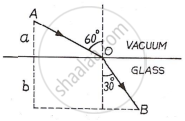
A ray of light AO in a vacuum is incident on a glass slab at an angle of 60° and refracted at an angle of 30° along OB as shown in the figure. The optical path length of the light ray from A to B is ______.
With a neat labelled ray diagram explain the use of Fresnel's biprism to obtain two coherent sources.
In biprism experiment, the 3rd dark band is formed opposite to one of the slits. The wavelength of light used is ______.
(D = distance between source and screen, d = distance between the two narrow slits)
