Advertisements
Advertisements
प्रश्न
Obtain the equation for bandwidth in Young’s double slit experiment.
Advertisements
उत्तर
- Condition for bright fringe (or) maxima:
The condition for the constructive interference or the point P to be have a bright fringe is,
Path difference, δ = nλ
where, n = 0,1,2,…….. ∴ `"dy"/"D"` = nl
y = `"n" (lambda"D")/"d"` (or)
`"y"_"n" = "n" (lambda"D")/"d"` - Condition for dark fringe (or) minima:
The condition for the destructive interference or the point P to be have a dark fringe is,
Path difference δ = (2n -1) `λ/2`
when, n = 1, 2, 3,………..
∴ y = `(2"n" - 1)/2 (lambda"D")/"d"` (or)
`"y"_"n" = (2"n" - 1)/2 (lambda"D")/"d"` - Equation for bandwidth:
- The bandwidth (β) is defined as the distance between any two consecutive bright or dark fringes.
- The distance between (n+l)th and nth consecutive brigh fringes from O is given by,
β = `"y"_("n + 1") - "y"_"n" (("n + 1")(lambda"D")/"d") - ("n" (lambda"D")/"d")`β = `(lambda"D")/"d"`
APPEARS IN
संबंधित प्रश्न
State any one difference between interference of light and diffraction of light
Answer in brief:
Explain what is the optical path length. How is it different from actual path length?
Answer in brief:
In Young's double-slit experiment what will we observe on the screen when white light is incident on the slits but one slit is covered with a red filter and the other with a violet filter? Give reasons for your answer.
Draw a neat labelled ray diagram of the Fresnel Biprism experiment showing the region of interference.
Explain constructive and destructive interference with the help of a diagram?
What is interference of light?
How do source and images behave as coherent sources?
In Young’s double-slit experiment, 62 fringes are seen in the visible region for sodium light of wavelength 5893 Å. If violet light of wavelength 4359 Å is used in place of sodium light, then what is the number of fringes seen?
A graph is plotted between the fringe-width Z and the distance D between the slit and eye-piece, keeping other adjustment same. The correct graph is
A.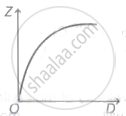 |
B.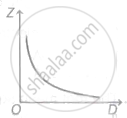 |
C.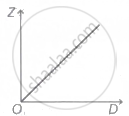 |
D.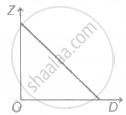 |
Band width for red light of wavelength 6600 Å is 0.42 mm. If red Light is replaced by blue light of wavelength 4400 Å, then the change m bandwidth will be ____________.
In a double slit experiment, the two slits are 2 mm apart and the screen is placed 1 m away. A monochromatic light of wavelength 500 nm is used. What will be the width of each slit for obtaining ten maxima of double slit within the central maxima of single slit pattern?
In a biprism experiment, D = 1 m, `lambda` = 6000 Å. When a convex lens is interposed between the biprism ru1d the eyepiece, then the distance between the images of the slits given by the Jens at two positions are 1.5 mm and 6.0 mm. The fringe width will be ______.
In Young's double slit experiment fifth dark fringe is formed opposite to one of the slits. If D is the distance between the slits and the screen and d is the separation between the slits, then the wavelength of light used is ______.
In biprism experiment, the 4th dark band is formed opposite to one of the slits. The wavelength of light used is ______.
Two identical light sources s1 and s2 emit light of same wavelength `lambda`. These light rays will exhibit interference if their ______.
Two waves with same amplitude and frequency superpose at a point. The ratio of resultant intensities when they arrive in phase to that when they arrive 90° out of phase is ______.
`[cos pi/2=0]`
A double slit experiment is immersed in water of refractive index 1.33. The slit separation is 1 mm, distance between slit and screen is 1.33 m. The slits are illuminated by a light of wavelength 6300 Å. The fringe width is ______.
In Young's double-slit experiment, the distance between the slits is 3 mm and the slits are 2 m away from the screen. Two interference patterns can be obtained on the screen due to light of wavelength 480 nm and 600 run respectively. The separation on the screen between the 5th order bright fringes on the two interference patterns is ______
Show graphically the intensity distribution in a single slit diffraction pattern.
The path difference between two interference light waves meeting at a point on the screen is `(87/2)lambda`. The band obtained at that point is ______.
