Advertisements
Advertisements
प्रश्न
What are the common types of secondary structure of proteins?
Advertisements
उत्तर
The secondary structure of protein refers to the shape in which a long polypeptide chain can exist. They are found to exist in two different types of structures, viz., an α-helix and a β-pleated sheet structure. These structures arise due to the regular folding of the backbone of the polypeptide chain due to hydrogen bonding between \[\begin{array}{cc}\ce{O}\\||\\\ce{-C-}\end{array}\] and –NH– groups of the peptide bond.
α-Helix is one of the most common ways in which a polypeptide chain forms all possible hydrogen bonds by twisting into a right handed screw (helix) with the –NH group of each amino acid residue hydrogen bonded to the \[\begin{array}{cc}\backslash\phantom{.....}\\\ce{C=O}\\/\phantom{......}\end{array}\] of an adjacent turn of the helix as shown in the figure.

α-Helix structure of proteins
In β-pleated sheet structure, all peptide chains are stretched out to nearly maximum extension and then laid side by side, which are held together by intermolecular hydrogen bonds. The structure resembles the pleated folds of drapery and therefore is known as a β-pleated sheet.
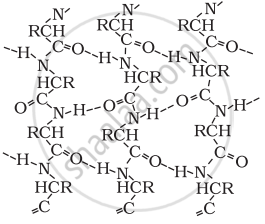
β-Pleated sheet structure of proteins
APPEARS IN
संबंधित प्रश्न
Discuss the optical activity of lactic acid.
Define the following as related to proteins:
Peptide linkage
What type of bonding helps in stabilising the α-helix structure of proteins?
Write one difference between α-helix and β-pleated structures of proteins.
Which of the following biomolecules is insoluble in water?
The helical structure of protein is stabilized by:
The correct statement for protein haemoglobin.
Which of the following statement is correct:
Proteins are found to have two different types of secondary structures viz. α-helix and β-pleated sheet structure. α-helix structure of protein is stabilised by:
Optical rotations of some compounds along with their structures are given below which of them have D configuration.
| (I) |  |
| (II) |  |
| (III) |  |
α-Helix is a secondary structure of proteins formed by twisting of polypeptide chain into right-handed screw like structures. Which type of interactions are responsible for making the α-helix structure stable?
Explain formation of peptide linkage in protein with an example.
Given below are two statements labelled as Assertion (A) and Reason (R).
Assertion (A): Proteins are found to have two different types of secondary structures viz alpha-helix and beta-pleated sheet structure.
Reason (R): The secondary structure of proteins is stabilized by hydrogen bonding.
Select the most appropriate answer from the options given below:
The correct structure of Ruhemann's Purple, the compound formed in the reaction of ninhydrin with proteins is:
An α-helix is a structural feature of ______.
Assertion (A): Proteins are polymers of α-amino acids connected by a peptide bond.
Reason (R): A tetrapeptide contains 4 amino acids linked by 4 peptide bonds.
