Advertisements
Advertisements
प्रश्न
What are the common types of secondary structure of proteins?
Advertisements
उत्तर
The secondary structure of protein refers to the shape in which a long polypeptide chain can exist. They are found to exist in two different types of structures, viz., an α-helix and a β-pleated sheet structure. These structures arise due to the regular folding of the backbone of the polypeptide chain due to hydrogen bonding between \[\begin{array}{cc}\ce{O}\\||\\\ce{-C-}\end{array}\] and –NH– groups of the peptide bond.
α-Helix is one of the most common ways in which a polypeptide chain forms all possible hydrogen bonds by twisting into a right handed screw (helix) with the –NH group of each amino acid residue hydrogen bonded to the \[\begin{array}{cc}\backslash\phantom{.....}\\\ce{C=O}\\/\phantom{......}\end{array}\] of an adjacent turn of the helix as shown in the figure.

α-Helix structure of proteins
In β-pleated sheet structure, all peptide chains are stretched out to nearly maximum extension and then laid side by side, which are held together by intermolecular hydrogen bonds. The structure resembles the pleated folds of drapery and therefore is known as a β-pleated sheet.
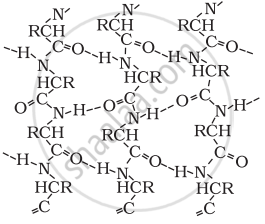
β-Pleated sheet structure of proteins
APPEARS IN
संबंधित प्रश्न
What type of bonding helps in stabilising the α-helix structure of proteins?
Differentiate between the following:
Fibrous proteins and Globular proteins
Write one difference between α-helix and β-pleated structures of proteins.
Differentiate between the following :
Peptide linkage and Glycosidic linkage
Which of the following biomolecules is insoluble in water?
The helical structure of protein is stabilized by:
Which functional group participates in disulphide bond formation in proteins?
Proteins are found to have two different types of secondary structures viz. α-helix and β-pleated sheet structure. α-helix structure of protein is stabilised by:
Optical rotations of some compounds along with their structures are given below which of them have D configuration.
| (I) |  |
| (II) |  |
| (III) |  |
α-Helix is a secondary structure of proteins formed by twisting of polypeptide chain into right-handed screw like structures. Which type of interactions are responsible for making the α-helix structure stable?
Which moieties of nucleosides are involved in the formation of phosphodiester linkages present in dinucleotides? What does the word diester in the name of linkage indicate? Which acid is involved in the formation of this linkage?
Each polypeptide in a protein has amino acids linked with each other in a specific sequence. This sequence of amino acids is said to be ______.
Peptide linkage is:
Presence of disulphide link gives rise to which structure of protein?
The correct structure of Ruhemann's Purple, the compound formed in the reaction of ninhydrin with proteins is:
Proteins are polymers of ______.
Match List I with List II:
| List I | List II |
| A. GLUT-4 | I. Hormone |
| B. Insulin | II. Enzyme |
| C. Trypsin | III. Intercellular ground substance |
| D. Collagen | IV. Enables glucose transport into cells |
Choose the correct answer from the options given below:
Statement I: A protein is imagined as a line, the left end represented by first amino acid (C-terminal) and the right end represented by last amino acid (Nterminal).
Statement II: Adult human haemoglobin, consists of 4 subunits (two subunits of a type and two subunits β type.)
In the light of the above statements, choose the correct answer from the options given below:
