Advertisements
Advertisements
प्रश्न
Which moieties of nucleosides are involved in the formation of phosphodiester linkages present in dinucleotides? What does the word diester in the name of linkage indicate? Which acid is involved in the formation of this linkage?
Advertisements
उत्तर
When nucleoside is linked to phosphoric acid at 5-position of sugar moiety, it forms a nucleotide. Nucleotides are joined together by phosphodiester link between 5' and 3' carbon atoms of the pentose sugar.
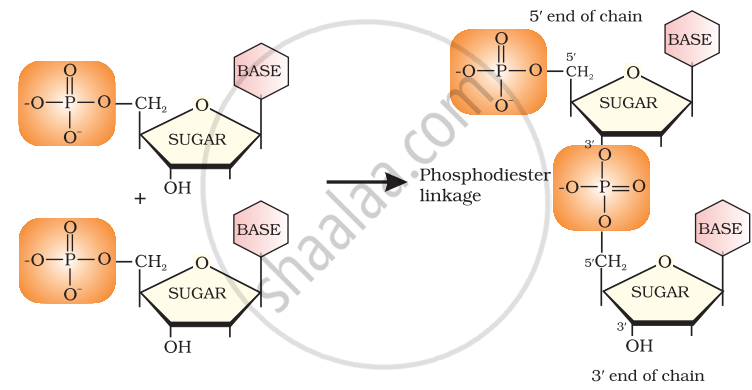
Phosphoric acid is involved in the formation of this linkage.
APPEARS IN
संबंधित प्रश्न
Discuss the optical activity of lactic acid.
Differentiate between the following :
Peptide linkage and Glycosidic linkage
Which of the following statement is correct:
Proteins are found to have two different types of secondary structures viz. α-helix and β-pleated sheet structure. α-helix structure of protein is stabilised by:
In fibrous proteins, polypeptide chains are held together by:
(i) van der Waals forces
(ii) disulphide linkage
(iii) electrostatic forces of attraction
(iv) hydrogen bonds
Which of the following are purine bases?
(i) Guanine
(ii) Adenine
(iii) Thymine
(iv) Uracil
Explain the terms primary and secondary structure of proteins. What is the difference between α-helix and β-pleated sheet structure of proteins?
Each polypeptide in a protein has amino acids linked with each other in a specific sequence. This sequence of amino acids is said to be ______.
Peptide linkage is:
Out of the following, which type of interaction is responsible for the stabilisation of the α-helix structure of proteins?
An α-helix is a structural feature of ______.
Proteins are polymers of ______.
Assertion (A): Proteins are polymers of α-amino acids connected by a peptide bond.
Reason (R): A tetrapeptide contains 4 amino acids linked by 4 peptide bonds.
What is the effect of denaturation on the structure of proteins?
Match List I with List II:
| List I | List II |
| A. GLUT-4 | I. Hormone |
| B. Insulin | II. Enzyme |
| C. Trypsin | III. Intercellular ground substance |
| D. Collagen | IV. Enables glucose transport into cells |
Choose the correct answer from the options given below:
Statement I: A protein is imagined as a line, the left end represented by first amino acid (C-terminal) and the right end represented by last amino acid (Nterminal).
Statement II: Adult human haemoglobin, consists of 4 subunits (two subunits of a type and two subunits β type.)
In the light of the above statements, choose the correct answer from the options given below:
