Advertisements
Advertisements
प्रश्न
What are the atomic numbers of elements whose outermost electrons is represented by 3p5?
Advertisements
उत्तर
3p5
Completing the electron configuration of the element as
1s2 2s2 2p6 3s2 3p5
∴ Number of electrons present in the atom of the element = 2 + 2 + 6 + 2 + 5 = 17
∴ Atomic number of the element = 17
APPEARS IN
संबंधित प्रश्न
With the help of given Table, find out the mass number of oxygen.
| Composition of Atoms of the First Eighteen Elements with Electron Distribution in Various Shells | ||||||||||
| Name of Element | Symbol | Atomic Number | Number of protons | Number of Neutrons | Number of Electrons | Distribution of Electrons | Valency | |||
| K | L | M | N | |||||||
| Hydrogen | H | 1 | 1 | - | 1 | 1 | - | - | - | 1 |
| Helium | He | 2 | 2 | 2 | 2 | 2 | - | - | - | 0 |
| Lithium | Li | 3 | 3 | 4 | 3 | 2 | 1 | - | - | 1 |
| Beryllium | Be | 4 | 4 | 5 | 4 | 2 | 2 | - | - | 2 |
| Boron | B | 5 | 5 | 6 | 5 | 2 | 3 | - | - | 3 |
| Carbon | C | 6 | 6 | 6 | 6 | 2 | 4 | - | - | 4 |
| Nitrogen | N | 7 | 7 | 7 | 7 | 2 | 5 | - | - | 3 |
| Oxygen | O | 8 | 8 | 8 | 8 | 2 | 6 | - | - | 2 |
| Fluorine | F | 9 | 9 | 10 | 9 | 2 | 7 | - | - | 1 |
| Neon | Ne | 10 | 10 | 10 | 10 | 2 | 8 | - | - | 0 |
| Sodium | Na | 11 | 11 | 12 | 11 | 2 | 8 | 1 | - | 1 |
| Magnesium | Mg | 12 | 12 | 12 | 12 | 2 | 8 | 2 | - | 2 |
| Aluminium | Al | 13 | 13 | 14 | 13 | 2 | 8 | 3 | - | 3 |
| Silicon | Si | 14 | 14 | 14 | 14 | 2 | 8 | 4 | - | 4 |
| Phosphorus | P | 15 | 15 | 16 | 15 | 2 | 8 | 5 | - | 3.5 |
| Sulphur | S | 16 | 16 | 16 | 16 | 2 | 8 | 6 | - | 2 |
| Chlorine | Cl | 17 | 17 | 18 | 17 | 2 | 8 | 7 | - | 1 |
| Argon | Ar | 18 | 18 | 22 | 18 | 2 | 8 | 8 | 0 | |
The composition of the nuclei of two atomic species X and Y are given as under
| X | Y | |
| Protons | 6 | 6 |
| Neutrons | 6 | 8 |
Give the mass numbers of X and Y. What is the relation between the two species?
What are the atomic numbers of elements whose outermost electrons is represented by 3s1.
Fill in the blank
An ion which has a positive charge is called a ..................
WRITE SHORT ANSWER
Define the atomic mass number of an atom.
Fill in the following blanks :
| Atomic Number | Mass Number | Protons | Neutrons | Electrons | Symbol |
| 10 | 22 | _________ | _________ | _________ | _________ |
From the symbol `""_15^31"P"`, state : atomic number of phosphorus
The atomic number of four elements A, B, C and D are 12, 13, 15 and 3 respectively. The element which cannot form a cation is :
From the symbol `""_2^4"He"` for the element helium, write down the mass number and the atomic number of the element.
An atom of an element has two electrons in the M shell.
What is the (a) atomic number (b) number of protons in this element?
Match the atomic numbers 4,8,10,15 and 19 with the following:
Element which can form trivalent ion
Match the atomic numbers 4,8,10,15 and 19 with the following:
Element with 6 valence electrons
The diagram represents an isotope of hydrogen [H]. Answer the following:
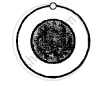
Atomic no. = 1
Mass no. = 1
If an isotope of ‘H’ has mass no. = 3, how many neutrons does it have.
Draw the structure of the following atoms showing the nucleus containing – protons, neutrons and the orbits with the respective electron:
Carbon [At. no. = 6, Mass no. = 12]
Differentiate between the following term:
Atomic number and mass number
Atomic number : ______ :: Mass number : Number of protons and neutrons.
The particles that make up the atom are called ______ particles.
K and L shells can accommodate a maximum of 2 and 8 electrons respectively.
Match the following:
| Column A | Column B | ||
| 1. | K shell | a. | 8 |
| 2. | L shell | b. | 32 |
| 3. | M shell | c. | 2 |
| 4. | N shell | d. | 18 |
If M is the atomic mass and A is the mass number, then packing fraction is given by ______.
