Advertisements
Advertisements
प्रश्न
Draw the atomic diagram of the following element showing the distribution of – protons, neutrons and the electrons in the various shell of the atom.
Carbon – \[\ce{^12_6C}\]
[The upper number represent the – mass number and the lower number represent the – atomic number e.g. calcium – mass number = 40, atomic number = 20]
Advertisements
उत्तर
Carbon – \[\ce{^12_6C}\]
Mass number A = p + n = 12
6 + n = 12
∴ n = 12 − 6 = 6
e = p = Atomic number = 6
C
6 = 2, 4
(K, L)
APPEARS IN
संबंधित प्रश्न
FILL IN THE BLANK
Rutherford won the Nobel Prize in 1908 for his investigations in the field of ......................
Fill in the Blank of the Following Statement :
An atom has atomic mass number 23 and atomic number 11. The atom has .................... electrons.
Fill in the blank of the following statement :
All the mass of an atom is concentrated in a small region of space called the ___________.
The atom of an element is made up of 4 protons, 5 neutrons and 4 electrons. What are its atomic number and mass number?
From the symbol `""_2^4"He"` for the element helium, write down the mass number and the atomic number of the element.
Draw the atomic diagram of the following element showing the distribution of – protons, neutrons and the electrons in the various shell of the atom.
Argon – \[\ce{^40_18Ar}\]
[The upper number represent the – mass number and the lower number represent the – atomic number e.g. calcium – mass number = 40, atomic number = 20]
The diagram represents an isotope of hydrogen [H]. Answer the following:
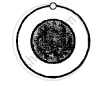
Atomic no. = 1
Mass no. = 1
If an isotope of ‘H’ has mass no. = 2, how many electrons does it have.
Elements X, Y, Z have atomic numbers 6, 9 and 12 respectively. Which one:
- forms anion – negative ion;
- forms cation – positive ion;
- has 4 electrons in the outermost orbit. [Y, Z, X]
Atomic number : ______ :: Mass number : Number of protons and neutrons.
‘A’ is denoted by ______.
