Advertisements
Advertisements
प्रश्न
Draw the atomic diagram of the following element showing the distribution of – protons, neutrons and the electrons in the various shell of the atom.
Oxygen – \[\ce{^16_8O}\]
[The upper number represent the – mass number and the lower number represent the – atomic number e.g. calcium – mass number = 40, atomic number = 20]
Advertisements
उत्तर
Oxygen – \[\ce{^16_8O}\]
Atomic number Z = p = e = 8
Mass number A = p + n
16 = 8 + n
∴ n = 16 − 8 = 8
O
8 = 2, 6
(K, L)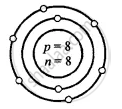
APPEARS IN
संबंधित प्रश्न
Fill in the blanks.
Isotopes are the atoms of ______ element having the ______ atomic number but ______ mass number.
Write true or false for the following statement
An atom on the whole has a positive charge.
What are the two main features of Rutherford’s atomic model?
Name the particles which actually determine the mass of an atom.
The mass number of an element is 18. It contains 7 electrons. What is the number of protons and neutrons in it? What is the atomic number of the element?
Sulphur has an atomic number 16 and a mass of 32.
State the number of protons and neutrons in the nucleus of sulphur. Give a simple diagram to show the arrangement of electrons in an atom of sulphur.
Elements X, Y and Z have atomic numbers 6, 9 and 12 respectively. Which one:
- Forms an anion
- Forms a cation
- Has four electrons in its valence shell?
Draw the structure of the following atoms showing the nucleus containing – protons, neutrons and the orbits with the respective electron:
Silicon [At. no. = 14, Mass no. = 28]
From the symbol \[\ce{^4_2He}\] for the element helium, write down the mass number and the atomic number of the element.
In which one of the following, the number of protons is greater than the number of neutrons but number of protons is less than the number of electrons?
