Advertisements
Advertisements
प्रश्न
What are the atomic numbers of elements whose outermost electrons is represented by 3s1.
Advertisements
उत्तर
3s1
Completing the electron configuration of the element as
1s2 2s2 2p6 3s1.
∴ Number of electrons present in the atom of the element
= 2 + 2 + 6 + 1 = 11
∴ Atomic number of the element = 11
APPEARS IN
संबंधित प्रश्न
Dalton said that ______ could not be divided.
Multiple Choice Questions
The sum of number of protons and number of neutrons present in the nucleus of an atom is called its
The atom of an element is made up of 4 protons, 5 neutrons and 4 electrons. What is its atomic number and mass number?
Tick the most appropriate answer.
Which of these have similar chemical properties but different set of physical properties and mass number?
- isobars
- elements
- isotopes
- none of these
WRITE SHORT ANSWER
Define the atomic mass number of an atom.
Fill in the blank of the following statement :
The total number of protons and neutrons in the nucleus of an atom is called its _________.
The number of electrons in the atom of an element X is 15 and the number of neutrons is 16. Which of the following is the correct representation of an atom of this element ?
An atom of an element has two electrons in the M shell.
What is the (a) atomic number (b) number of protons in this element?
Match the atomic numbers 4,8,10,15 and 19 with the following:
Element which can form trivalent ion
Draw the atomic diagram of the following element showing the distribution of – protons, neutrons and the electrons in the various shell of the atom.
Calcium – \[\ce{^40_20Ca}\]
[The upper number represent the – mass number and the lower number represent the – atomic number e.g. calcium – mass number = 40, atomic number = 20]
Match the statements in List I with the correct answer from List II.
| List I | List II |
| 1. Mass number of an atom is the number of protons and | A: Electron |
| 2. The sub-atomic particle with a negligible mass. | B: Argon |
| 3. An atom having stable electronic configuration. | C: Nitrogen |
| 4. A molecule formed by sharing of electrons [covalency] | D: Sodium |
| 5. A metallic atom having unstable electronic configuration. | E: Neutrons |
The diagram represents an isotope of hydrogen [H]. Answer the following:
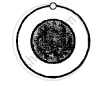
Atomic no. = 1
Mass no. = 1
If an isotope of ‘H’ has mass no. = 3, how many neutrons does it have.
Elements X, Y, Z have atomic numbers 6, 9 and 12 respectively. Which one:
- forms anion – negative ion;
- forms cation – positive ion;
- has 4 electrons in the outermost orbit. [Y, Z, X]
Differentiate between the following term:
Atomic number and mass number
The atomic number and the mass number of an element is 26 and 56 respectively. Calculate the number of electrons, protons and neutrons in its atom. Draw the structure.
Explain the following terms.
- Proton
- Electron
- Neutron.
Every atom has an equal number of protons and electrons. The nature of the atom is ______.
Electrons revolve around the nucleus in definite open shells.
Match the following:
| Column A | Column B | ||
| 1. | K shell | a. | 8 |
| 2. | L shell | b. | 32 |
| 3. | M shell | c. | 2 |
| 4. | N shell | d. | 18 |
A group of elements in the periodic table is given below (Boron is the first member of the group and Thallium is the last).
Boron, Aluminium, Gallium, Indium, Thallium
Answer the following question in relation to the above group of elements:
The atomic number of boron is 5. Write the chemical formula of the compound formed when boron reacts with chlorine.
