Advertisements
Advertisements
प्रश्न
What are cathode rays? Why are they called ‘cathode rays’? Name a material which exhibits fluorescence when cathode rays fall on it.
Advertisements
उत्तर
Cathode rays are the stream of negatively charged particles called electrons. They are called cathode rays because they are given out from cathode in a discharge tube operating at about 10,000 V when the pressure inside the tube is about 0.01 mm of Hg. Zinc Sulphide exhibits fluorescence when cathode rays fall on it.
संबंधित प्रश्न
What happens if the negative potential is changed on a grid?
Radiations given out from a source when subjected to an electric field in a direction perpendicular to their path are shown below in the diagram. The arrows show the path of the radiation A, B and C. Answer the following questions in terms of A, B and C.
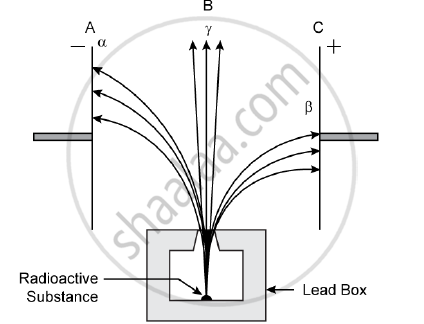
1) Name the radiation B which is unaffected by the electrostatic field.
2) Why does the radiation C deflect more than A?
3) Which among the three causes the least biological damage externally.
4) Name the radiation which is used in carbon dating.
What do you mean by Atomic number
A radioactive substance is oxidized. What changes would you expect to take place in the nature of radioactivity? Explain your answer.
Why are materials of low work function preferred as thermionic cathode materials?
How is a cathode ray tube used to convert an electrical signal into a visual signal?
An electrons emitter must have how much work function and melting point.
The count rate of activity of a radioactive sample of a very large population decreased from 1024 to 128 in 3 minutes. Then the rate of disintegration at the end of 5 minutes is ______.
The activity of a certain radionuclide decreases to 15 percent of its original value in 10 days. What is its half life?
[ln (0.15) = -1.9]
