Advertisements
Advertisements
प्रश्न
Define the term radioactivity.
Advertisements
उत्तर
The phenomenon of spontaneous disintegration of an unstable nucleus of a naturally occurring isotope accompanied by emission of active radiations, α particles, β particles and γ radiations is called radioactivity.
APPEARS IN
संबंधित प्रश्न
Give one example of isobars.
In the following fig. shows a radioactive source S in a thick lead container. The radiations pass through an electric field between the plates P and Q. Complete the diagram to show the paths of α , β and γ radiations.
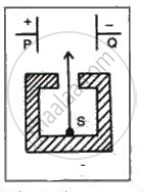
Why is the source S placed in a thick lead container?
Explain the use of radioactive in the field of medicine, agriculture and industry.
During the emission of a beta particle, the ______ number remains same.
Name the three main parts of a Cathode Ray Tube.
Justify with reason, whether the following nuclear reactions are allowed or not.
\[\ce{^A_Z X -> ^A_{Z + 1}Y + ^0_{-1}β}\]
From α, β and γ-rays, name the one which is not affected by electric or magnetic field?
What is the value of the speed of gamma radiations in air or vacuum?
Explain, why radium paint, consisting of zinc sulphide and a trace of radium salt, glows in the dark?
If 10% of a radioactive substance decays in every 5 years, then the percentage of the substance that will have decayed in 20 years will be ______.
