Advertisements
Advertisements
प्रश्न
When is said to be the nucleus unstable?
Advertisements
उत्तर
The nucleus is said to be unstable when radiations (alpha, beta, gamma rays) are emitted by the nucleus.
APPEARS IN
संबंधित प्रश्न
A radiation X is focused by a particular device on the bulb of a thermometer and mercury in the thermometer shows a rapid increase. Name the radiation X
An element `""_ZS^A` decays to `""_85R^222` after emitting 2 α particles and 1 β particle.
Find the atomic number and atomic mass of the element S.
Arrange α, β, and γ rays in ascending order with respect to their
1) Penetrating power.
2) Ionising power
3) Biological effect
State the energy conversion taking place in a cathode ray tube
An electromagnetic radiation is used for photography in fog. [2]
(i) Identify the radiation.
(ii) Why is this radiation mentioned by you, ideal for this purpose ?
Give the relative ionizing power of α, β and γ radiations.
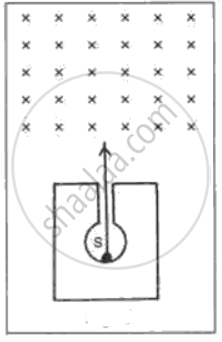
In following fig. shows a mixed source S of alpha and beta particles in a thick lead container. The particles pass through a magnetic field in a direction perpendicular to the plane of paper (inwards as shown by x). State and show in the diagram how the particles get affected.
What is nucleus of an atom? Compare its size with that of the atom. Name its constitutents. How is the number of these constituents determined by the atomic number its atomic model.
What do you mean by electron emission?
In a cathode ray tube state the purpose of covering cathode by thorium and carbon.
Name a common device where a hot cathode ray tube is used.
Name the Different Radiations Which Are Emitted by the Radioactive Substances.
Are all the radiations mentioned by you, emitted in a single radioactive decay?
Are all the radiations viz. α, β and γ emitted in a single radioactive decay?
Heavy radioactive elements eventually turn into ______.
The half-life of a radioactive nuclide is 100 hours. The fraction of original activity that will remain after 150 hours would be ______.
A deuteron strikes 8O16 nucleus with subsequent emission of an alpha particle. Identify the nucleus so produced:
Assertion (A): The force of repulsion between atomic nucleus and α-particle varies with distance according to inverse square law.
Reason (R): Rutherford did α-particles scattering experiment.
While investigating which phenomena was Becquerel studying uranium salts when he discovered radioactivity?
