Advertisements
Advertisements
प्रश्न
When is said to be the nucleus unstable?
Advertisements
उत्तर
The nucleus is said to be unstable when radiations (alpha, beta, gamma rays) are emitted by the nucleus.
APPEARS IN
संबंधित प्रश्न
Name the radiations which are absorbed by greenhouse gases in the earth’s atmosphere.
Write one use of cathode ray tube.
Name the unit in which the work function of a metal is expressed.

Complete the diagram as given above by drawing the deflection of radioactive radiations in an electric field
Radiations given out from a source when subjected to an electric field in a direction perpendicular to their path are shown below in the diagram. The arrows show the path of the radiation A, B and C. Answer the following questions in terms of A, B and C.
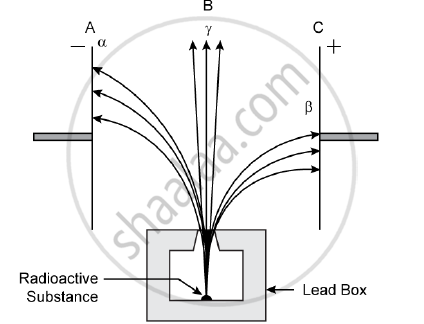
1) Name the radiation B which is unaffected by the electrostatic field.
2) Why does the radiation C deflect more than A?
3) Which among the three causes the least biological damage externally.
4) Name the radiation which is used in carbon dating.
State two dissimilarities between the γ-rays and X-rays.
State the penetrating range of α, β and γ radiations.
What happens to the mass number of an element when (i) an α -particle, (ii) a β -particle, and (iii) γ -radiation is emitted?
What kind of change takes place in a nucleus when a β -particle is emitted?
What are the uses of radioactive isotopes in following?
(a) Medical field,
(b) Agriculture,
(c) Industries?
A nucleus of an element X which has the symbol `""_84^202` X emits an alpha particle and then a beta particle. The final nucleus is `""_"b"^"a"` Y Find a and b.
Name two radioactive substances.
Define bound electrons.
An electrons emitter must have how much work function and melting point.
State three common properties of beta rays and cathode rays.
State one use of radio-isotopes.
Mention four properties of Becquerel rays.
When an α-particle of mass m moving with velocity ν bombards on a heavy nucleus of charge Ze, its distance of closest approach from the nucleus depends on m as:
Which type of radioactive emission is strongly ionising in nature?
