Advertisements
Advertisements
प्रश्न
What happens to the atomic number of element when (i) An α -particle, (ii) A β -particle 1 and (iii) γ-radiation is emitted?
Advertisements
उत्तर
(i) α particle is represented by 2He4 this means it contains 2 protons so after emitting a α particle atomic number of element would decrease bv 2 unit.
(ii) β particle is represented by -1θ° after emitting a β particle atomic number of element would increase bv 1 unit.
(iii) Y radiations have no charge and no mass so after emitting a Y radiation atomic number of element remain unchanged.
संबंधित प्रश्न
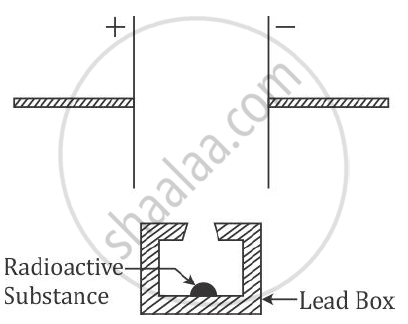
Complete the diagram as given above by drawing the deflection of radioactive radiations in an electric field
State the penetrating range of α, β and γ radiations.
Give the relative ionizing power of α, β and γ radiations.
A radioactive nuclide `""_86^226` Ra decays by emission of two alpha particles, one beta particle and gamma rays. Which of the following is the resulting nuclide X?
A certain nucleus A (mass number 238 and atomic number 92) is radioactive and becomes a nucleus B (mass number 234 and atomic number 90) by the loss of one particle.
What particle was emitted?
Mention four properties of Becquerel rays.
In U238 ore containing Uranium the ratio of U234 to Pb206 nuclei is 3. Assuming that all the lead present in the ore is final stable product of U238. Half life of U238 to be 4.5 × 10⁹ years and the age of ore is ______ × 109 years. (in 109 years)
If 10% of a radioactive substance decays in every 5 years, then the percentage of the substance that will have decayed in 20 years will be ______.
Two radioactive materials A and B have decay constants 25λ and 16λ respectively. If initially they have the same number of nuclei, then the ratio of the number of nuclei of B to that of A will be "e" after a time `1/("a"lambda)` The value of a ______.
Assertion (A): The force of repulsion between atomic nucleus and α-particle varies with distance according to inverse square law.
Reason (R): Rutherford did α-particles scattering experiment.
