Advertisements
Advertisements
प्रश्न
Why do Free electrons not leave the metal surface on their own
Advertisements
उत्तर
Free electrons cannot leave the metal surface on their own because they do not have sufficient kinetic energy.
APPEARS IN
संबंधित प्रश्न
State three factors on which the rate of emission of electrons from a metal surface depends
Radiations given out from a source when subjected to an electric field in a direction perpendicular to their path are shown below in the diagram. The arrows show the path of the radiation A, B and C. Answer the following questions in terms of A, B and C.
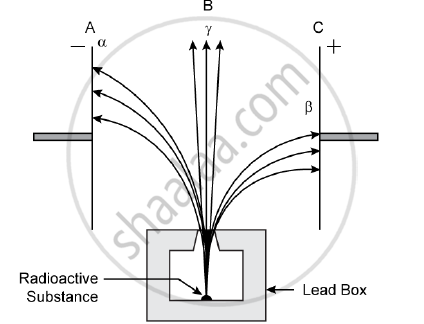
1) Name the radiation B which is unaffected by the electrostatic field.
2) Why does the radiation C deflect more than A?
3) Which among the three causes the least biological damage externally.
4) Name the radiation which is used in carbon dating.
What happens to the atomic number of element when (i) An α -particle, (ii) A β -particle 1 and (iii) γ-radiation is emitted?
Draw a diagram of a simple atom showing the nucleus and electrons. In this atom:
(a) What type of charge will there be on the nucleus?
(b) What is the value of this charge?
In a cathode ray tube state. How is it possible to increase the rate of emission of electrons.
Two radioactive nuclei are represented by xAp and yAq and when p and q are mass numbers and x, y are the atomic number. How can the products be represented, i .e., what are the new values of p, q. x and y after the emission of an α-particle and a β-particle from A and B respectively.
Mention one important function of ear main parts:
State the principle on which the functioning of a nuclear reactor is based.
The activity of a certain radionuclide decreases to 15 percent of its original value in 10 days. What is its half life?
[ln (0.15) = -1.9]
Calculate the time interval between 33% decay and 67% decay if half-life of a substance is 20 minutes.
