Advertisements
Advertisements
प्रश्न
Radiations given out from a source when subjected to an electric field in a direction perpendicular to their path are shown below in the diagram. The arrows show the path of the radiation A, B and C. Answer the following questions in terms of A, B and C.
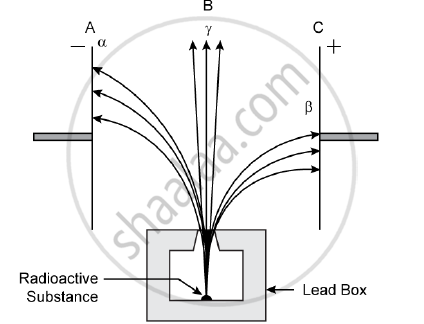
1) Name the radiation B which is unaffected by the electrostatic field.
2) Why does the radiation C deflect more than A?
3) Which among the three causes the least biological damage externally.
4) Name the radiation which is used in carbon dating.
Advertisements
उत्तर
1) Gamma radiations
2) Because of the mass of B particle is less than that of α, hence radiation deflects more than A.
3) `gamma` rays
4) beta radiation `""_6^14C -> ""_7^14N + ""_(-1)^0beta^(-)`
APPEARS IN
संबंधित प्रश्न
Answer the following questions based on a hot cathode ray tube.
State the approximate voltage used to heat the filament
State the energy conversion taking place in a cathode ray tube
Name the unit in which the work function of a metal is expressed.
State any two precautions to be taken while handling radioactive substances.
What do you mean by Atomic number
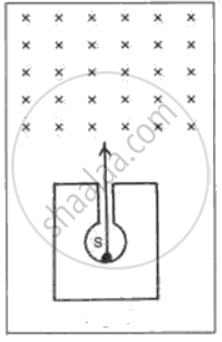
In following fig. shows a mixed source S of alpha and beta particles in a thick lead container. The particles pass through a magnetic field in a direction perpendicular to the plane of paper (inwards as shown by x). State and show in the diagram how the particles get affected.
A radioactive nucleus `""_"Z"^"A"` X first emits a beta particle and then an alpha particle to give the resulting nucleus `""_"Q"^"P"` Y What will be the values of P and Q in terms of A and Z?
How is a cathode ray beam affected while passing through an electric field?
88Ra226 experiences three α - decay. Find the number of neutrons in the daughter element.
Two radioactive materials A and B have decay constants 25λ and 16λ respectively. If initially they have the same number of nuclei, then the ratio of the number of nuclei of B to that of A will be "e" after a time `1/("a"lambda)` The value of a ______.
