Advertisements
Advertisements
प्रश्न
The two graphs below compare Car A and Car B. The left graph shows the relationship between age and value. The right graph shows the relationship between size and maximum speed.
 |
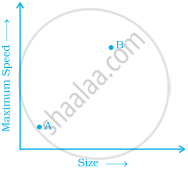 |
Use the graphs to determine whether each statement is true or false, and explain your answer.
- The older car is less valuable.
- The faster car is larger.
- The larger car is older.
- The faster car is older.
- The more valuable car is slower.
Advertisements
उत्तर
- False, the older car is 8 i.e. 8 valuable more than car A.
- True, in the second graph 8 is larger car having greater speed.
- True, larger car is 8 which is older than A.
- True, as 8 is faster as well as older than A.
- False, as 8 is more valuable but not slower.
APPEARS IN
संबंधित प्रश्न
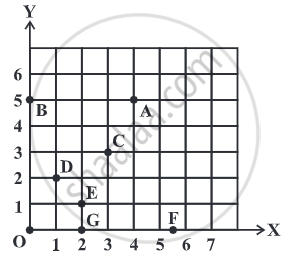
The point (3, 4) is at a distance of ______.
The process of fixing a point with the help of the coordinates is known as ______ of the point.
The point where the two axes intersect is called the ______.
Write the y-coordinate (ordinate) of the given point.
(2, 7)
Plot the given points on a graph sheet and check if the points lie on a straight line. If not, name the shape they form when joined in the given order.
(1, 1), (1, 2), (2, 1), (2, 2)
If y-coordinate is 3 times x-coordinate, form a table for it and draw a graph.
Explain the situations represented by the following distance-time graph.

Locate the points A(1, 2), B(4, 2) and C(1, 4) on a graph sheet taking suitable axes. Write the coordinates of the fourth point D to complete the rectangle ABCD.
Locate the points A(1, 2), B(3, 4) and C(5, 2) on a graph sheet taking suitable axes. Write the coordinates of the fourth point D to complete the rhombus ABCD. Measure the diagonals of this rhombus and find whether they are equal or not.
