Advertisements
Advertisements
प्रश्न
The least count of a vernier callipers is 0.01 cm and it has an error of + 0.07 cm. While measuring the radius of a sphere, the main scale reading is 2.90 cm and the 5th vernier scale division coincides with the main scale. Calculate the correct radius.
Advertisements
उत्तर
Least count (L.C.) = 0.01 cm
Error = + 0.07 cm
Correction = (Error) = – (+ 0.07) = – 0.07 cm
Main scale reading = 2.90 cm
Vernier scale division (V.S.D.) coinciding with main scale = 5th Observed diameter of sphere = Main scale reading + L.C. × V.S.D.
= 2.90 + 0.01 × 5
= 2.90 + 0.05
= 2.95 cm
Corrected diameter = Observed diameter + Correction
= 2.95 + (−0.07)
= 2.95 – 0.07
= 2.88 cm
∴ Corrected radius = 2.88/2 = 1.44 cm
APPEARS IN
संबंधित प्रश्न
The wavelength of light of a particular colour is 5800 Å.
Express it in metre.
State three uses of the vernier callipers.
What is the need for measuring length with vernier callipers?
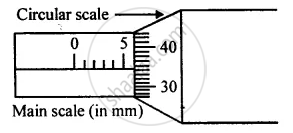
Figure shows a screw gauge in which circular scale has 200 divisions. Calculate the least count and radius of the wire.
How will you find the Zero Error of Vernier Caliper? Explain.
In a vernier calipers, (N + 1) divisions of vernier scale coincide with N divisions of main scale. If 1 MSD represents 0.1 mm, the vernier constant (in cm) is ______.
