Advertisements
Advertisements
प्रश्न
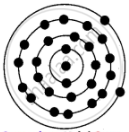
The atomic number and the mass number of an element is 26 and 56 respectively. Calculate the number of electrons, protons and neutrons in its atom. Draw the structure.
Advertisements
उत्तर
Given:
Atomic number A = 26
Mass number A = 56
No. of Protons P = ?
No. of Electrons = ?
No. of Neutrons N = ?
Name of the element is Iron (Fe)
No. of proton (P) = 26
Mass number A = n+p
56 = n = 26
n = 56-26
∴ No. of neutrons n = 30
In an element No. of protons and No. of electrons is equal.
∴No of electrons = no. of protons
= 26
Structure of Iron:
APPEARS IN
संबंधित प्रश्न
What are the atomic numbers of elements whose outermost electrons is represented by 3p5?
Give the following a suitable word/phrase.
Atoms of same element with same atomic number but a different mass number.
Multiple Choice Questions
The sub atomic particle with negative charge is
The atomic number and the mass number of sodium are 11 and 23 respectively. What information is conveyed by this statement.
TRUE \ FALSE
After the emission of a beta-particle, the atomic number of the atom increases by one.
Fill in the blank of the following statement :
All the mass of an atom is concentrated in a small region of space called the ___________.
From the symbol `""_12^24"Mg"`
, state the mass number, the atomic number and electronic configuration of magnesium.
Match the atomic numbers 4,8,10,15 and 19 with the following:
Element with four shells
What is common salt? Name the elements present in it. Write the formula of common salt. What are the atomic number and the mass number of the elements? Write the ions in the compound.
What is mass number of an atom?
