Advertisements
Advertisements
प्रश्न
The area of the quadrilateral ABCD, where A(0,4,1), B(2, 3, –1), C(4, 5, 0) and D(2, 6, 2), is equal to ______.
पर्याय
9 sq.units
18 sq.units
27 sq.units
81 sq.units
Advertisements
उत्तर
The area of the quadrilateral ABCD, where A(0,4,1), B(2, 3, –1), C(4, 5, 0) and D(2, 6, 2), is equal to 9 sq.units.
Explanation:
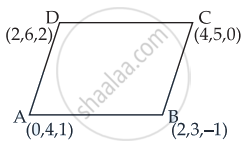
Given points are A(0, 4, 1), B(2,3,– 1), C(4, 5, 0) and D(2,6,2)
D’ratios of AB = 2,–1 –2
And d’ratios of DC = 2,–1,–2
∴ AB||DC
Similarly, d’ratios of AD = 2, 2, 1 and d’ratios of BC = 2, 2, 1
∴ AD || BC
So ABCD is a parallelogram
`vec"AB" = 2hat"i" - hat"j" - 2hat"k"`
`vec"AD" = 2hat"i" + 2hat"j" + hat"k"`
∴ Area of parallelogram ABCD = `|vec"AB" xx vec"AD"|`
= `|(hat"i", hat"j", hat"k"),(2, -1, -2),(2, 2, 1)|`
= `hat"i"(-1 + 4) - hat"j"(2 + 4) + hat"k"(4 + 2)`
= `3hat"i" - 6hat"j" + 6hat"k"`
= `sqrt((3)^2 + (-6)^2 + (6)^2)`
= `sqrt(9 + 36 + 36)`
= `sqrt(81)`
= 9 sq.units
APPEARS IN
संबंधित प्रश्न
Find the direction cosines of the line
`(x+2)/2=(2y-5)/3; z=-1`
If l1, m1, n1 and l2, m2, n2 are the direction cosines of two mutually perpendicular lines, show that the direction cosines of the line perpendicular to both of these are m1n2 − m2n1, n1l2 − n2l1, l1m2 − l2m1.
If the lines `(x-1)/(-3) = (y -2)/(2k) = (z-3)/2 and (x-1)/(3k) = (y-1)/1 = (z -6)/(-5)` are perpendicular, find the value of k.
If a line makes angles of 90°, 60° and 30° with the positive direction of x, y, and z-axis respectively, find its direction cosines
Using direction ratios show that the points A (2, 3, −4), B (1, −2, 3) and C (3, 8, −11) are collinear.
Find the angle between the vectors with direction ratios proportional to 1, −2, 1 and 4, 3, 2.
Find the acute angle between the lines whose direction ratios are proportional to 2 : 3 : 6 and 1 : 2 : 2.
Show that the line through points (4, 7, 8) and (2, 3, 4) is parallel to the line through the points (−1, −2, 1) and (1, 2, 5).
Show that the line through the points (1, −1, 2) and (3, 4, −2) is perpendicular to the line through the points (0, 3, 2) and (3, 5, 6).
Define direction cosines of a directed line.
What are the direction cosines of Z-axis?
If a line makes angles α, β and γ with the coordinate axes, find the value of cos2α + cos2β + cos2γ.
Write the coordinates of the projection of point P (x, y, z) on XOZ-plane.
If a line has direction ratios proportional to 2, −1, −2, then what are its direction consines?
For every point P (x, y, z) on the xy-plane,
For every point P (x, y, z) on the x-axis (except the origin),
If P (3, 2, −4), Q (5, 4, −6) and R (9, 8, −10) are collinear, then R divides PQ in the ratio
If a line makes angles α, β, γ, δ with four diagonals of a cube, then cos2 α + cos2 β + cos2γ + cos2 δ is equal to
Find the direction cosines of the line joining the points P(4,3,-5) and Q(-2,1,-8) .
Find the direction cosines of a vector whose direction ratios are
1, 2, 3
Find the direction cosines and direction ratios for the following vector
`3hat"i" - 4hat"j" + 8hat"k"`
A triangle is formed by joining the points (1, 0, 0), (0, 1, 0) and (0, 0, 1). Find the direction cosines of the medians
If (a, a + b, a + b + c) is one set of direction ratios of the line joining (1, 0, 0) and (0, 1, 0), then find a set of values of a, b, c
Choose the correct alternative:
The unit vector parallel to the resultant of the vectors `hat"i" + hat"j" - hat"k"` and `hat"i" - 2hat"j" + hat"k"` is
Find the direction cosines of the line passing through the points P(2, 3, 5) and Q(–1, 2, 4).
A line makes equal angles with co-ordinate axis. Direction cosines of this line are ______.
If a line makes angles `pi/2, 3/4 pi` and `pi/4` with x, y, z axis, respectively, then its direction cosines are ______.
If the directions cosines of a line are k,k,k, then ______.
The direction cosines of vector `(2hat"i" + 2hat"j" - hat"k")` are ______.
Find the direction cosine of a line which makes equal angle with coordinate axes.
If a line has the direction ratio – 18, 12, – 4, then what are its direction cosine.
If a line makes angles of 90°, 135° and 45° with the x, y and z axes respectively, then its direction cosines are ______.
Find the coordinates of the image of the point (1, 6, 3) with respect to the line `vecr = (hatj + 2hatk) + λ(hati + 2hatj + 3hatk)`; where 'λ' is a scalar. Also, find the distance of the image from the y – axis.
If a line makes an angle α, β and γ with positive direction of the coordinate axes, then the value of sin2α + sin2β + sin2γ will be ______.
A directed line makes angles \[\alpha\], \[\beta\], and \[\gamma\] with the positive x-, y-, and z-axes respectively. What are these angles called?
Which identity must be satisfied by the direction cosines \[(l,m,n)\] of a line?
