Advertisements
Advertisements
प्रश्न
Present Progressive
(Progressive = continuous)
Form

S +is/ am/ are +verb+ ing
S +is/ am/ are+ not+ verb+ ing.
Is/am/me+ S + verb+ing?
S + is/ am/ are +being+ Verb (past participle)
- Complete the following sentences by filling in the blanks with the present progressive form of the given verbs.
i. "You've put on weight, Cheryl."
"Yes. I.. .... (eat) a lot these days."
ii. "Hurry up! We ... (get) late for school."
"Justa second, please! I ... (come}."
iii. Temperatures ... (rise} all over the world.
iv. "You .... not ... (wear) this dirty shirt to office. Wait, I'll give you another."
v. "l...not ... (do) your homework-forget it. I still haven't forgotten how you
fought with me in the morning."
vi. The Prime Minister ... (leave) for Russia tomorrow on a 5 day state visit.
Vii "You ... (be) ver:yrude, Abhi."
viii. She ... always (make) excuses for coming late.
ix. Aabha ... (write) a novel these days.
- The table below shows different uses or meanings of the present progressive. Match the verbs in the above sentences with the uses or meanings they convey.
| a. Something pre-arranged or a fixed plan ............ b. Insistence............. c. Annoyance............ d. Repeated action............. e. Some development or change........... f. Emphatic refusal............. g. Something happening 'around now'.............. h. An action just starting.......... i. Temporary action not necessarily taking place at the moment of speaking............ |
*It is a little difficult to match the sentences with uses of present progressive
tense. Here are the answers:
a-vi, b-iv, c-vii, d-i, e-iii, f-v, g-ix, h-ii, i-viii.
Compare your answers with these and have a class discussion.
Advertisements
उत्तर
(i) am eating
(ii) are getting, am coming
(iii) are rising
(iv) are, wearing
(v) am, doing
(vi) is leaving
(vii) are
(viii) makes
(ix) writing
| (a) Something pre-arranged or a fixed plan | is leaving |
| (b) Insistence | are, wearing |
| (c) Annoyance | are |
| (d) Repeated action | am eating |
| (e) Some development or change | are rising |
| (f) Emphatic refusal | am, doing |
| (g) Something happening 'around now' | writing |
| (h) An action just starting | are getting, am coming |
| (i) Temporary action not necessarily taking place at the moment of speaking | am eating |
APPEARS IN
संबंधित प्रश्न
Now compare your answers with those of your partner and discuss the
following questions and write your observations in the given space.
a. Is the time referred to in the sentences always the same as the tense of
the verb? What conclusion can you draw from your observation? Write
your observation below.
...............................................................................................................................................
..................................................................................................................................................
b. How have you found the tense of the verbs in the sentences above? Are
there any indicators or markers that reveal the tense of the verb? Write
your observation below.
...............................................................................................................................................
..................................................................................................................................................
c. Did you find any verb form that could be called 'future form'? (You will
learn more about the different ways of talking about future later in this
unit.)
...............................................................................................................................................
..................................................................................................................................................
d. Why do you think verb forms are often labelled as 'simple' or 'indefinite', 'progressive' or 'continuous', 'perfect' and 'perfect continuous'?
...............................................................................................................................................
..................................................................................................................................................
Verbs that are normally NOT used in the progressive form.
1. Which sentence in each of the following pairs is acceptable and
why?
1. a. I am respecting you.
b. I respect you.
2. a. My son loves to draw and paint.
b. My son is loving to draw and paint.
3. a. We are having two cars.
b. We have two cars.
4. a. I am thinking you are new to this place.
b. I think you are new to this place.
5. a. The cake smells good.
b. The cake is smelling good.
| Verbs referring to mental states (eg. know, think, believe etc) and to the use of the senses (eg. smell, taste etc) are never, or hardly ever, used in progressive forms. Some of these verbs are: believe prefer know suppose feel sound (dis)like love realise understand hear taste see hate recognise want see belong doubt imagme remember wish smell agree possess own owe involve include depend |
Can you explain the difference between?
1. a. l justcan'timaginehowyougotintosuchamess.
b. You're imagining things nothing will happen.
2. a. The coffee tastes bitter
b. Mother is tasting coffee to check ifit is too bitter.
3. a. My teacher admires my art work
b. She is admiring the latest painting I have made.
4. a. The doctor is feeling the patient's pulse.
b. The patient is feeling better.
Present Perfect vs. Simple Past
a. Explain the difference in the meaning of the following pairs of
sentences. You may like to use the given hints.
1. a. I have been a teacher for five years.
b. I was a teacher for five years.
(Hint: Is the speaker still a teacher?)
2. a. I always got good marks in English.
b. I have always got good marks in English.
(Hint: Is the speaker still studying?)
3. a. Geeta has never met her cousin.
b. Geeta never met her cousin.
(Hint: Is Geeta's cousin alive?)
4. a. I have never been to Timbuktu.
b. I never went to Timbuktu.
(Is the speaker talking about a particular journey or his travels so far?)
5. a. Jose has completed seven assignments today.
b. Jose completed seven assignments today.
(Hint: Is the day over? Has Jose more assignments to write?)
Study the following picture carefully and then write a paragraph to describe what is happening.
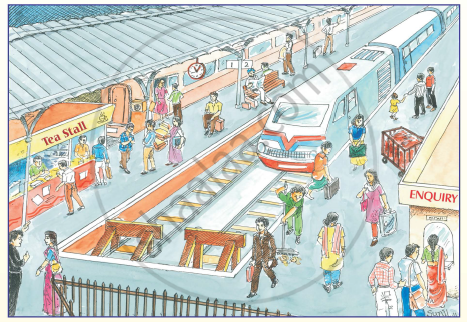
Look at the incomplete sentences below. Using the information provided, complete each sentence using a suitable tense. Follow the examples:
1947 until now India I has been (be) independent since 1947.
1947 India became (become) independent in 1947.
1. 1947 until now l There --------- (be) manywars.
2. 1991 There ------- (be) a war in the Persian Gulf.
3. 1953 -------- Edmund Hilary and Tensing first (climb) Everest.
4. 1953 until now Many people ________ (climb)Everest.
5. 1983 India --------- (win) the Prudential Cricket World Cup in England.
6. 1983 until now India -------- (win) many limited-overs cricket trophies.
What has been the situation of your village/town/city five to ten years ago and how has it changed since then? Write a short paragraph describing the changes in its size, population, traftlc, buildings, lifestyle etc. Which verb forms would you mainly use to describe the changes? (Hint: Simple Past and Present Perfect forms.)
Study the following sentences.
1) I didn't know Jim had migrated to the United States.
2) When we arrived at the theatre, the show had already begun.
3) The patient had died before the ambulance reached the hospital.
4) He had got married by the time he started working.
5) I couldn't open the locker because I had mislaid the keys.
6) Byom Bakshi felt that he had seen the man somewhere before.
As you can see, each of the above sentences describes two different actions, events or situations. Work with a partner and list them as shown in the example.
| A. Occurred First | B. Occurred Later |
| 1. Example: Jim had migrated to the United States. | 1. I did not know it. The speaker came to know the fact later.) |
| 2. | 2. |
| 3. | 3. |
| 4. | 4. |
| 5. | 5. |
| 6. | 6. |
What verb forms have been used in (A) and (B) respectively?
A. ....................................................................
B ....................................................................
What conclusion can you draw from your analysis?
...................................................................
...................................................................
The Dauphin will give me all I need.
(Rewrite the sentence using the present perfect tense)
Name the Tense of the Verb underlined to include Time (Past/Present/Future) and Aspect (Simple/Continuous/Perfect/Perfect Continuous).
I am fine, now.
Name the Tense of the Verb underlined to include Time (Past/Present/Future) and Aspect (Simple/Continuous/Perfect/Perfect Continuous).
I have been facing death.
Change the Tense as instructed.
I got fired. (Future Perfect)
Change the Tense as instructed.
Life hits you in the head. (Present Perfect Continuous)
Change the Tense as instructed.
The dots will somehow connect. (Past Perfect)
Rewrite the sentence as per the instruction given along with it.
She surveyed the area for the vicious male langur.
(Rewrite the sentence in the Simple Future Tense)
Rewrite the sentence as per the instruction given along with it.
I took the baby langur to our backyard.
(Rewrite the sentence in the Past Perfect Tense)
Underline the verb and choose the correct option from the options.
Today Sanjay found a new book.
(present tense/past tense)
Underline the verb and choose the correct option from the options.
They are sportsmen.
(singular/plural)
Read the following sentence carefully, underline the verb and find out the tense in the sentence.
Still they took no notice of him.
Read the following sentence carefully, underline the verb and find out the tense in the sentence.
He leaned out eagerly.
