Advertisements
Advertisements
प्रश्न
One requires 11eV of energy to dissociate a carbon monoxide molecule into carbon and oxygen atoms. The minimum frequency of the appropriate electromagnetic radiation to achieve the dissociation lies in ______.
पर्याय
visible region.
infrared region.
ultraviolet region.
microwave region.
Advertisements
उत्तर
One requires 11eV of energy to dissociate a carbon monoxide molecule into carbon and oxygen atoms. The minimum frequency of the appropriate electromagnetic radiation to achieve the dissociation lies in ultraviolet region.
Explanation:
Given energy required to dissociate a carbon monoxide moleule into carbon and oxygen atoms E = 11eV
We know that E = hv, where h = 6.62 × 10⁻³⁴ J – s
v = frequency
⇒ 11 eV = hv
⇒ ` v = (11 xx 1.6 xx 10^-19)/(6.62 xx 10^-34) J`
= `2.65 xx 10^15` Hz
This frequency radiation belongs to ultraviolet region.
APPEARS IN
संबंधित प्रश्न
A wave has a wavelength of 10-3 nm. Name the wave.
Can Lα X-ray of one material have shorter wavelength than Kα X-ray of another?
If the potential difference applied to the tube is doubled and the separation between the filament and the target is also doubled, the cutoff wavelength
Moseley's Law for characteristic X-ray is √v = a(Z − b). Here,
X-ray incident on a material
(a) exerts a force on it
(b) transfers energy to it
(c) transfers momentum to it
(d) transfers impulse to it.
Find the cutoff wavelength for the continuous X-rays coming from an X-ray tube operating at 30 kV.
(Use Planck constant h = 4.14 × 10⁻¹⁵ eVs, speed of light c = 3 × 10⁸ m/s.)
What potential difference should be applied across an X-ray tube to get X-ray of wavelength not less than 0.10 nm? What is the maximum energy of a photon of this X-ray in joule?
(Use Planck constant h = 6.63 × 10⁻³⁴ Js= 4.14 × 10⁻¹⁵ eVs, speed of light c = 3 × 10⁸ m/s.)
The wavelength of Kα X-ray of tungsten is 21.3 pm. It takes 11.3 keV to knock out an electron from the L shell of a tungsten atom. What should be the minimum accelerating voltage across an X-ray tube having tungsten target which allows production of Kα X-ray?
(Use Planck constant h = 6.63 × 10⁻³⁴ Js= 4.14 × 10⁻¹⁵ eVs, speed of light c = 3 × 10⁸ m/s.)
The electron beam in a colour TV is accelerated through 32 kV and then strikes the screen. What is the wavelength of the most energetic X-ray photon?
(Use Planck constant h = 6.63 × 10⁻³⁴ Js= 4.14 × 10⁻¹⁵ eVs, speed of light c = 3 × 10⁸ m/s.)
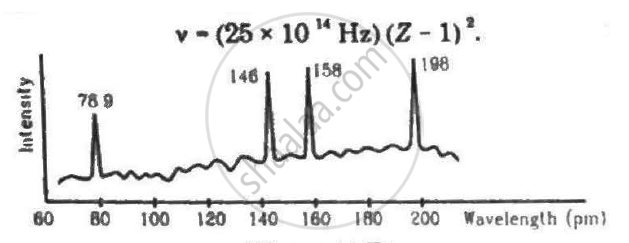
Continuous X-rays are made to strike a tissue paper soaked with polluted water. The incoming X-rays excite the atoms of the sample by knocking out the electrons from the inner shells. Characteristic X-rays are analysed and the intensity is plotted against the wavelength. Assuming that only Kα intensities are detected, list the elements present in the sample from the plot. Use Moseley's equation v − (25 × 1014Hz)(Z − 1)2.
(Use Planck constant h = 6.63 × 10⁻³⁴ Js= 4.14 × 10⁻¹⁵ eVs, speed of light c = 3 × 10⁸ m/s.)
Name the scientist who discovered Visible light
Name the scientist who discovered radio waves
Two waves A and B have wavelength 0.01 Å and 9000 Å respectively.
Name the two waves. compare the speeds of these waves when they travel in vacuum.
Give one use of electromagnetic radiations in Infrared radiation.
Answer briefly.
What are radio waves?
Radio waves of constant amplitude can be generated with.
Given below in the left column are different modes of communication using the kinds of waves given in the right column.
| A. | Optical Fibre Communication |
P. | Ultrasound |
| B. | Radar | Q. | Infrared Light |
| C. | Sonar | R. | Microwaves |
| D. | Mobile Phones | S. | Radio Waves |
From the options given below, find the most appropriate match between entries in the left and the right column.
What is the speed of radio waves in vacuum?
In an atom X, electrons absorb the energy from an external source. This energy “excites” the electrons from a lower-energy level to a higher-energy level around the nucleus of the atom. When electrons return to the ground state, they emit photons.
The figure below is the energy level diagram of atom X with three energy levels, E1 = 0.00eV, E2 = 1.78eV and E3 = 2.95eV. The ground state is considered 0 eV for reference. The transition of electrons takes place between levels E1 and E2.

- What wavelength of radiation is needed to excite the atom to energy level E2 from E1?
- Suppose the external source has a power of 100 W. What would be the rate of photon emission?
At what speed do all electromagnetic waves travel in a vacuum?
