Advertisements
Advertisements
प्रश्न
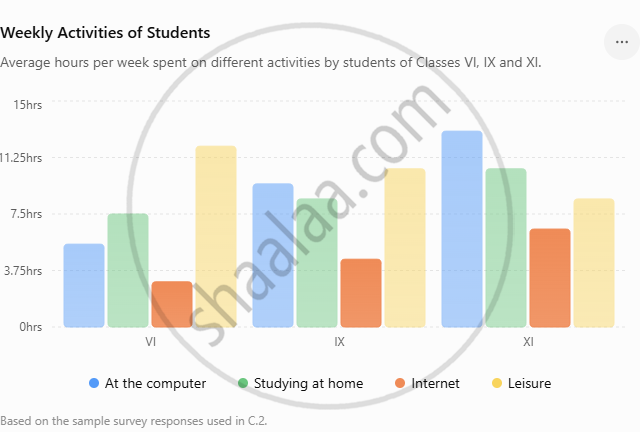
Now prepare a graph based on the students' response to the survey you conducted in Question 2. Then write a report for the newspaper taking the help of Question 5, Question 3 and Question 6. You may follow this pattern:
Paragraph 1 : A suitable introduction as in B.4.
Paragraph 2 : Hours per week spent on different activities - classes VI, IX and XI compared.
Paragraph 3 : How extra time would be used - Classes VI, IX and XI compared.
Paragraph 4 : Boys and girls compared - Classes VI, IX and XI
The following words and phrases will be useful to you:
To express proportion
Most __
Many __
The majority of ___
A large number of ___
A small number of ___
Very few ____
Only a few ___
To express frequency
Most of the time ___
Frequently ___
Occasionally ___
Often ____
At times ___
To express comparison and contrast
__ compared with __
On the other hand, ___
In contrast, ___
By comparison, ___
___ however, ___
____ in comparison with ___
You may also find some of the phrases from B.5 useful.
Advertisements
उत्तर
Do it yourself
APPEARS IN
संबंधित प्रश्न
Why did the women at the temple discuss the latest episode of ‘Kashi Yatre’?
Here is a story about Swami and his grandmother. After reading the excerpt, change it into a conversation between Swami and his Grandmother.
After the night meal with his head on his granny’s lap, nestling close to her, Swaminathan felt very snug and safe in the faint atmosphere of cardamom and cloves. ‘Oh, Granny !’ he cried ecstatically. ‘You don’t know what a great fellow Rajam is.’ He told her the story of the first enmity between Rajam and Mani and the subsequent friendship.
‘You know, he has a real police dress,’ said Swaminathan. ‘Is it? What does he want a police dress for?’ asked Granny.
‘His father is the Police Superintendent. He is the master of every policeman here.’ Granny was impressed. She said that it must be a tremendous office indeed. She then recounted the days when her husband, Swaminathan’s grandfather, was a powerful sub-magistrate, in which office he made the police force tremble before him and the fiercest dacoits of the place flee. Swaminathan waited impatiently for her to finish the story. But she went on, rambled, confused, mixed up various incidents that took place at different times. ‘That will do, Granny,’ he said ungraciously. ‘Let me tell you something about Rajam. Do you know how many marks he gets in arithmetic?’
‘He gets all the marks, does he, child?’ asked Granny.
‘No silly. He gets ninety marks out of one hundred.’
‘Good. But you must also try and get marks like him…. You know, Swami, your grandfather used to frighten the examiners with his answers sometimes. When he answered a question, he did it in a tenth of the time that others took to do it. And then, his answers would be so powerful that his teachers would give him two hundred marks sometimes.
‘Oh, enough, Granny ! You go on bothering about old unnecessary stories. Won’t you listen to Rajam?’
‘Yes, dear, yes.’
‘Granny, when Rajam was a small boy, he killed a tiger.’
Swaminathan started the story enthusiastically : Rajam’s father was camping in a forest. He had his son with him. Two tigers came upon them suddenly, one knocking down the father from behind. The other began chasing Rajam, who took shelter behind a bush and shot it dead with his gun.
‘Granny, are you asleep?’ Swaminathan asked at the end of the story.
Now read the dialogue and complete the conversation:
Swarni: You don’t know what a great fellow Raj am is! In the beginning I could not get along with him but now he is my good friend. And you know, he has a real police dress.
Grandmother: Is it? What does he want a police dress for?
Swarni: His father is the Police Superintendent. He is the master of every policeman here.
Grandmother: I think, it must be a tremendous office. Do you know, your grandfather was a powerful submagistrate and the Police Force trembled before him? Even the fiercest dacoits of the place fled.
Swarni: That will do, Granny. It’s so boring. Let me tell you something about Raj am. Do you know how many marks he gets in arithmetic?
Grandmother: He gets all the marks, doesn’t he, child?
The ‘Professor’ knew too much. How did he prove himself ? Fill up the space with suitable examples from the story, using the given clues :
(a) about muzzle velocity : _____
(b) after a thirty mile walk : _____
(c) his salute on payday : ______
(d) the loud sound of a high flying invisible aeroplane : _______
(e) about hand grenades : _______
(f) during cook house duties :. _______
Answer the following questio briefly.
What does John say about himself since his last meeting with the author?
Answer the following questions:
‘I make the netted sunbeam dance’. What does ‘the netted sunbeam’ mean? How does it dance?
Identify the rhyme scheme of the poem.
(a) Listen to a recording of the poem.
(b) What choice did the poet have to make?
(c) Did he regret his choice? Why/why not?
In the sixth line of the first stanza, we read:
"... and sings a melancholy strain,..."
This "s" sound at the beginning of sings and strain has been repeated. Poets often do
this. Do you know why? Do you know what this "poetic repetition" is called? Can you
find other instances of this, in The Solitary Reaper?
On the basis of your understanding of the poem, answer the following question
by ticking the correct choice.
All the world's a stage is an extended metaphor for________.
On the basis of your understanding of the poem, answer the following question
by ticking the correct choice.
The title 'Oh, I wish I'd looked after me teeth' expresses __________.
Answer the following question.
With reference to the poem, how can you look after your teeth?
Imagine that a Social Worker comes to the abandoned farmhouse to find out what may have happened to the family. She makes the following observations in her note-pad
| Clues | Conclusions |
| empty house | Have they left? Where could they have gone to? |
| boulders in the field , leaky barn | The owner might not have been a farmer. |
| sealed jars in the cellar | A woman lived there - family short of money left in a hurry |
| toys scattered in the yard | Something went wrong????? |
On the basis of these notes, the Social Worker presents the facts as she sees them to her Head of Department. Unfortunately, she spills ink on her report. Complete her report.
When I reached the farmhouse , I saw that the house was empty , which ........ I wondered where they might have gone . .................. the owner was not a farmer , because of the boulders in the field and the leaky barn .............. the family was poor , because I saw several sealed jars in the cellar . Also ............ a woman lived there . It was obvious she had left in a hurry . what was most touching was that the toys were scattered in the yard .
Answer the following question briefly.
The convict says, "I am too old a bird to be caught with chaff." What does he mean
by this statement?
Choose one suitable word from the given options to complete the paragraph.
It’s in (a)_____middle of (b)_____night on (c)_____edge of the world. On the fringes of civilization, where man and beast have barely left (d) _____mark, 12 people are sleeping in small nylon tents pitched in the scant shelter of (e)_____mountains. The camp is at (f)_____mercy of the elements, (g)_____are volunteers who have set up camp to help gather (h)_____ information on (i)_____the snow leopard population. These conservationists have had very (j)_____or no scientific training. They, along with (k)_____guides intend to assess (l)_____ snow leopards habitat in (m)_______ Altai region, Siberia.
| (A) (i) x (ii) a (iii) an (iv) the |
| (B) (i) the (ii) some (iii) a (iv) one |
| (C) (i) a (ii) an (iii) the (iv) x |
| (D) (i) their's (ii) their (iii) his (iv) our |
| (E) (i) a (ii) x (iii) the (iv) some |
| (F) (i) x (ii) a (iii) an (iv) the |
| (G) (i) This (ii) There (iii) That (iv) These |
| (H) (i) some (ii) few (iii) x (iv) a few |
| (I) (i) x (ii) a (iii) an (iv) the |
| (J) (i) a little (ii) few (iii) some (iv) little |
| (K) (i) there (ii) their (iii) they're (iv) these |
| (L) (i) the (ii) a (iii) an (iv) x |
| (M) (i) an (ii) a (iii) x (iv) the |
Here are a police constable's notes or his investigation or the murder at Manor House. After reading the notes, discuss where the murder could have taken place. What was the motive behind the evil act? How was the act committed?
| Murder at Manor House Birlstone : January 6th Manor House - state of wild confusion and alarm - white faced servants - frightened butler - man horribly injured- terrible marks - we have no clues yet |
Past passive –
“Where was it made?”
Look at what your partner is wearing. Imagine where the various items of clothing were (or might have been) made, and tell your partner. Use your imagination!
e.g. A : Was your shirt made in France ?
B : No, actually it was made in Brazil.
Present perfect passive
Inspector Narayan has been called to investigate a burglary. When he arrives, there is total chaos in the room. He makes notes about what has been damaged. You are Inspector Narayan. Look at the picture and complete the description, using the Present Perfect Passive.

Look at the notes below. Then use the information to complete the paragraph by choosing a suitable word or phrase in each space.
Bishnois – always – nature worshippers – 1730 A.D. – Maharja Abhay Singh’s men – fell – khejri trees – Amrita Devi – hug a tree – protested – insisted – to cut her head first – men obliged – Amrita – a legend.
Bishnois have (a) ____________. In 1730 A.D. Maharaja Abhay Singh’s (b) ____________ fell Khajri trees. Amrita Devi, a true Bishnoi, (c) ____________ and expressed (d) ____________. She insisted that if they wanted to cut the tree (e) ____________. The unrelenting men of the Maharaja obliged her and the (f) ____________.
| (a) (i) always been regarded as nature worshippers (ii) always been called as nature worshippers (iii) always knew nature worshippers (iv) always done nature worshippers |
(b) (i) men coming to (ii) men started (iii) men began to (iv) men came to |
(c) (i) hug a tree (ii) hugging a tree (iii) hugged a tree (iv) hugs a tree |
| (d) (i) his protest (ii) her protest (iii) their protest (iv) protesting |
(e) (i) they may cut her head first (ii) they would have to cut her head first (iii) they can cut her head first (iv) they should cut her head first |
(f) (i) woman became a legend (ii) woman becomes a legend (iii) women became a legend (iv) woman read a legend |
SAID and TOLD
Be careful with the use of said and told. Look at these examples.
(a) He told me to stop work.
They told us they had four children.
She said (that) they were finished.
We said (that) we were leaving at 6 o’clock.
What would you use when ordering somebody to do something: told or said?
(b)
Fill in the blanks using said or told.
Add any other words that you think are necessary.
- He ________ to sit down and I did.
- She ________ the weather would be hot and it was.
- They ________ about the disaster and we listened carefully.
- He ________ to go away and they did.
- She ________ there was no other way to do it.
As children of the world, you have a role in helping to solve the problems prevalent in society. In groups or four, prepare a short skit on any one problem and present it in front of the class.