Advertisements
Advertisements
प्रश्न
Choose the correct answer and fill in the blanks:
(a) Cars enable you to reach any place you want. ____________ , they pose parking problems in the cities.
(b) I prefer writing __________
(c) He fell ___________ the ladder.
(d) John, as well as his younger brothers, _________ going abroad for further studies.
(e) You’d better take a taxi. ___________ , you’ll arrive late.
(f) It’s not a very good job. _____________ it’s something to start with.
| (a) (i) However (ii) Although (iii) Despite (iv) So that |
(b) (i) on (ii) in (iii) by (iv) with |
| (c) (i) on (ii) out (iii) of (iv) off |
(d) (i) is (ii) are (iii) have (iv) been |
| (e) (i) However (ii) Consequently (iii) Furthermore (iv) Otherwise |
(f) (i) Besides (ii) Moreover (iii) On the other hand (iv) But |
Advertisements
उत्तर
(a) Cars enable you to reach any place you want. however , they pose parking problems in the cities.
(b) I prefer writing in.
(c) He fell off the ladder.
(d) John, as well as his younger brother is going abroad for further studies.
(e) You’d better take a taxi. otherwise, you’ll arrive late.
(f) It’s not a very good job. but it’s something to start with.
APPEARS IN
संबंधित प्रश्न
Answer the following questio briefly.
What does John say about himself since his last meeting with the author?
Answer the following questions:
Why has the word ‘chatter’ been repeated in the poem?
Answer the following question briefly.
Which road does the speaker choose? Why?
Roads are fascinating as metaphors for life, change, journeys, partings,
adventure, etc. or simply as roads. This is probably why they, and all their
attendant images, have permeated art, literature and songs. In the poem, Frost
uses the fork in the road as a metaphor for the choices we make in life. Thus the
roads are, in fact, two alternative ways of life. What other nouns, according to
you could be used to represent life?
River
________________
________________
________________
________________
________________
On the basis of your understanding of the poem, answer the following question
by ticking the correct choice.
The speaker says that she has paved the way for cavities and decay by __________.
Answer the following question briefly.
Why does Jeanne want to buy a villa?
Answer the following question briefly.
Mrs. Al Smith makes many statements about the French. Pick out any two and explain
them.
Answer the following question briefly.
Juliette says "................... now I have only one thought that is to get the wretched place
off my hands. I would sacrifice it at any price", Does she stick to her words? Why / Why
not?
Answer the following question briefly.
The convict says, "I am too old a bird to be caught with chaff." What does he mean
by this statement?
Work in pairs and recognise how many words belong to each set. Complete the sentences as in the example. Use words only from the box above:
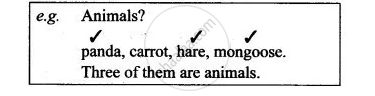
- Chemical elements?
Mercury, iron, ammonia__________ of___________ are chemical elements. - Countries in South America?
Brazil, Syria, Sumatra One____________ is a country in South America. - Rivers?
Hwang Ho, Mekong ____________ them are rivers. - Languages?
Telugu, Bengali, Punjabi, Holland____________are languages. - Capital cities?
Pokhara, Mandalay, New York, Melbourne___________of ____________a capital. - Grow on trees?
Pineapple, tomato_______________ of them grows on trees. - Religions?
Taoism, Democracy, Communism ____________of ____________ is a religion. - Units of currency?
rupee, kyat, yen, dollar, baht, rupiah ____________are units of currency.
In pairs discuss the qualities and characteristics of the tiger and man. Complete the web charts. 

Complete the following passage by choosing the correct option. The first one has been done as an example:
Martin Cooper, (a) _______ a Motorola researcher and executive, is widely (b) _______ to be the inventor (c)_______ the first mobile phone in 1973. There are (d) _______ categories of mobile phones (e)_______ from basic phones and feature phones (f)______ as music phones, camera phones to smart phones. The (g)_________commonly used data application on mobile phones (h)______ text messaging. Mobile phones generally (i)_______power from batteries which (j)_______ be recharged. The use of cellphones (k)_________ while driving as a safety measure.
| (a) (i) an (ii) the (iii) a (iv) X |
(b) (i) consider (ii) considered (iii) considering (iv) have considered |
(c) (i) for (ii) of (iii) as (iv) off |
(d) (i) many (ii) few (iii) much (iv) more |
| (e) (i) are ranging (ii) ranging (iii) range (iv) ranges |
(f) (i) some (ii) like (iii) such (iv) similar |
(g) (i) much (ii) more (iii) most (iv) many |
(h) (i) is (ii) are (iii) has been (iv) being |
| (i) (i) obtain (ii) is obtaining (iii) obtaining (iv) obtained |
(j) (i) would (ii) can (iii) may (iv) should |
(k) (i) ban (ii) was banned (iii) banning (iv) is banned |
First, you will hear a local radio programme, read out by teacher / student which is given below which will give you ideas for your own programme. First, listen without writing anything.
Presenter 1: A very good day to all our listeners. This is your local radio station, Class IX Local Radio - bringing you up-to-the - minute news, current affairs, music, interviews, round-ups - and much much more.
Presenter2: Yes, and in today's programme we have a special report from Ketaki Lahiri on "Safety at School".
Presenter 1: Nikhil Gomes brings you his regular weekly review of "Beyond the Timetable",
Presenter 2: And Leena invites you to "Meet the Teacher".
Presenter 1: And lots more - jokes, news -you name it and we have it. We start with the round-up of School News by our roving correspondent - Anant Singh. Anant, over to you.
Anant: Good morning, everybody! The highlight of this weeks' School News is that our school football team lost every single match it played in the YMCA football tournament at league level. The physical education teacher is so livid that he has threatened to make the school team practice on a doubletime schedule from tomorrow. So, friends, it's "wake-up" at 4 a.m for all footballers henceforth.
In another school news, the tiny tots were taken on a visit to the zoo. Some, it is said, did not wish to return. One accompanying teacher, we are told, had a tough time convincing them that life outside is better!
Class XII put on a one-act play "Examination Fever" which was written, directed and produced by them. The proceeds from this show are being sent to "Prathyasha" - an organisation that helps handicapped children.
Look out next week for new faces around the school. A group of 20 students from Japan are arriving on a cultural exchange programme, We might even get one of them on our next edition ofThe Class IX Radio Show!
Presenter 1: So ... Lots happening at school, it seems,-and lots more on your Local Radio. It's time for jokes now. Over to you, Hafeez and Aarohi.
Aarohi: Waiter , Waiter , what's wrong with these eggs ?
Hafeez: I don't know. I only laid the table;
Aarohi: Waiter, waiter, what's this fly doing in my soup?
Hafeez: Breaststroke, I think, Sir,
Teacher: I wish-you would pay a little more attention.
Pupil: I'm paying as little as I can.
Teacher: You should have been here at 9 o'clock.
Pupil: Why, what happened?
Presenter 2: Thank you, Hafeez and Aarohi. And don't forget, listeners, to send in your jokes. Every original joke will win you a reward of RslO/- for each one played on your favourite radio programme - Class IX Local Radio - the station just for you.
Presenter 1 : And now to your regular spot "Meet the Teacher", in which Leena interviews one of your favourite teachers to discover the real person "behind the chalk dust".
So it's all yours, Leena.
Leena: Thank you ! I'm delighted today to be able to interview the Head of the Science Department, Mr Chirag Sharma. Mr Sharma, what all our listeners are dying to know is - are you as strict at home as you are at school?
Mr Sharma: (Laughs heartily). I don't have a bunch of forty naughty children at home.
Leena: Did you ever get into trouble when you were at school?
Mr Sharma : Have you ever thought about how I am able to catch you in your tricks? I was usually up to the same tricks at school! No, I'm afraid my teachers were not very happy with me.
Leena: How good were you in your studies, Sir?
Mr Sharma: Ah, that was my strong point. My work was always up-to-date and fairly good. I was naughty, but I was also keen to learn more.
Leena: How do you spend your evenings and holidays, Sir?
Mr Sharma: I like to spend time at home with my teenage children. We have common tastes in music.
Leena: Any message for our listeners Sir?
Mr Sharma: Yes. Fun and-play have their place in our lives. We must enjoy our play. At the same time, we must work with enthusiasm and sincerity.
Leena: Thank you, sir !
Presenter 2 : Thank you Leena for that fascinating interview. I'm sure we all know, now what makes Mr Sharma 1tick1• And now it's time for a break. It's "advert time".
"Buy two but pay for one!"
Ruchita of VIIC has a fabulous offer. Two pencil boxes for the price of one. Pay Rs 5 / for the bargain.
Lost - A Keltron calculator. Krishna of Class XIIA has offered a treat in the school canteen to the finder.
Presenter 1: And now, a very serious subject. Ketaki has been researching the topic 'Safety at School'. She has come up with some very disturbing findings. This is the report. Ketaki?
Ketaki: As I went around the senior school I was alarmed to find a number of broken electric sockets with exposed wires. Beware of this hidden danger, senior students. That brings me to another danger - this time in the primary block. The lid of the ground level water tank is broken. Till it is repaired, students are warned not to go anywhere near it.
Presenter 2 : Well, time1s up boys and girls of Class IX Local Radio - bringing you news and entertainment of interest to you, in your school and locality. Until next week ...
Do you see any difference in the following sentences?
(a) You can use a ruler to dig holes.
(b) You can use my ruler to dig holes.
(c) You can find a ruler in the study room.
Can is used to express permission, ability, and possibility in these sentences.
In sentence (a) can is used to express ________.
In sentence (b) can is used to express ________ and,
in sentence (c) can is used to express ________.
Can, could, may, might, will, would, must, ought to, shall, should are called Modal verbs.
Look at the following pair of sentences. Underline the modals and discuss why each one is used in that sentence.
e.g.
I must not take those pills. (I’m not allowed.)
I need not take those pills. (It is not compulsory but I may if I wish.)
(b) I needn’t go to the meeting if I don’t wish to.
2. (a) I can swim a length of the pool.
(b) I can swim in the pool on Saturdays.
3. (a) You ought to get a nice present for her.
(b) You have to get a nice present for her.
4. (a) Can I go to the toilet?
(b) May I be excused?
5. (a) I may come tomorrow if I have the time.
(b) I might come tomorrow but it’s going to be difficult.
Did you know?
Modals are a small group of verbs that are used to express possibility,
probability, capability, capacity, ability, obligation and predictions.
Some of the modals you learnt in this unit are
can
may
shall
could
might
should
Need, dare, had better are also modals.
Understanding Modals:
Modal Auxiliaries
A modal verb or auxiliary verb is a verb, which modifies another verb, so that
the modified verb has more intention in its expression. In essence the modal
verb expresses modality, the way in which something is being said.
The main modals are
Can: could; may: might; shall: should; will: would: must; ought to; need to;
have to.
The negative modals are
Couldn't; wouldn't; shouldn't; mustn't; needn't; oughtn't/ ought not to
| Modal | Examples | Uses |
| Can/ can't |
She can read and write It can rain today Can I borrow your pen? Can you lend me your notes? Can I carry your books? |
ability possibility /probability seeking permission request offer |
| Could/ couldn't |
Could I borrow your book? Could you please help me with this sum? We could go for a picnic on Sunday I think you could come first this time There was a time when I could work round the clock. |
seeking permission request suggestion possibility/ probability past ability |
| May |
May I have some water? May I help you? May I shut the door? India may become a super power by 2020. May God bless you |
request offer permission possibility/ probability wish/ desire |
| Might | They might sell their house as they need the money. | future possibility/ probability |
| Will /Won't |
It is very cold so I will stay at home. I will help you if you wish. Will you look after my dog for a day? It will rain tonight. I will get you a shawl from Srinagar. |
intention offer request prediction promise |
| Would/Wouldn't |
Would you mind if I come over tonight? Would five o'clock suit you? Yes it would. Would you pass the salt? Would you come to my party? Would you prefer tea or coffee? |
permission making arrangements request invitation preference
|
| Shall |
Shall I help you? Shall we meet at 3.00 pm outside Bakshi Stadium? |
offer making arrangements |
| Should |
We should check the timings of the train. You should listen to the advice of your elders. |
recommended action advice |
| Ought to |
You ought to do your duty. The bus ought to be here any minute |
advice probability |
| Must/mustn't |
We must make a move now. You mustn't tell lies. |
obligation necessity |
| Need |
He need not go to the market. You need to lose weight. I need to get the groceries. |
necessity compulsion insistence |
Answer the following question by ticking the correct option.
The Manor House stood out because of its _______________
(9) Read these instructions from a computer operating manual.
How to start
- Link up the monitor, keyboard and printer.
- Plug in the main cable.
- Switch on the monitor at the back.
- When the light appears on the screen, place the Day Disk in Drive A.
- Push in the disk until the button clicks out.
(It takes about 30 seconds for the computer to load the programme.) - Press the Drive button and the disk shoots out.
- Replace the Day Disk with the Document Disk.
- Press function key 7.
- Start work!
Question 9.1
Convert these instructions into the past passive by filling in the blanks. The first sentence has been completed as an example.
Firstly the monitor keyboard and printer were linked up. Then the __________ was __________. The monitor __________ at the back. When the light appeared on the screen, __________ in Drive A. The disk __________ until __________. It took the computer 30 seconds to load the programme. The Drive button __________ and the disk shot out. The __________ with the Document Disk. Finally, __________
The word processor was then ready to use.
The song 'We Are the World' has been sung by many famous singers of the West. Do you know why it is called 'We Are the World'? Why was it recorded? What were the singers trying to do? Did they succeed?
Student/ teacher can sing the song.
Listen to the song and check whether you have guessed right in Question 1. Listen again until you are ready to sing along with it.
Rearrange the jumbled words to form meaningful sentences. Rewrite the sentences using appropriate punctuation marks:
(a) in 2004 / the Nobel Peace prize / Dr. Wangari Maathai / was awarded
_______________________________________________
(b) towards sustainable development / the award / was in / her service / recognition of
_______________________________________________
(c) Nairobi’s Uhuni Park / in 1989 / saved / single-handedly / she
_______________________________________________
(d) which is an NGO / she is / the Green Belt Movement / the founder of
_______________________________________________
_______________________________________________
(f) has earned / Dr. Wangari Maathai / “Tree Mother of Africa” / the title
_______________________________________________
