Advertisements
Advertisements
प्रश्न
Match the reactions given in Column I with the types of reactions given in Column II.
| Column I | Column II | |
| (i) | 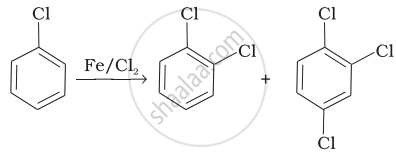 |
(a) Nucleophilic aromatic substitution |
| (ii) | \[\begin{array}{cc} \ce{CH3 - CH = CH2 + HBr -> CH3 - CH - CH3}\\ \phantom{............................}|\phantom{}\\ \phantom{.............................}\ce{Br}\phantom{} \end{array}\] |
(b) Electrophilic aromatic substitution |
| (iii) | 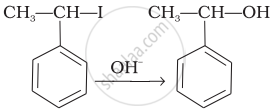 |
(c) Saytzeff elimination |
| (iv) | 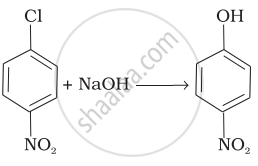 |
(d) Electrophilic addition |
| (v) | \[\begin{array}{cc} \ce{CH3 CH2 CH CH3 ->[alc.KOH] CH3 CH = CH CH3}\\ \phantom{}|\phantom{..........................}\\ \phantom{}\ce{Br}\phantom{........................} \end{array}\] |
(e) Nucleophilic substitution (SN1) |
Advertisements
उत्तर
| Column I | Column II | |
| (i) | |
(b) Electrophilic aromatic substitution |
| (ii) | \[\begin{array}{cc} \ce{CH3 - CH = CH2 + HBr -> CH3 - CH - CH3}\\ \phantom{............................}|\phantom{}\\ \phantom{.............................}\ce{Br}\phantom{} \end{array}\] |
(d) Electrophilic addition |
| (iii) | |
(e) Nucleophilic substitution (SN1) |
| (iv) | |
(a) Nucleophilic aromatic substitution |
| (v) | \[\begin{array}{cc} \ce{CH3 CH2 CH CH3 ->[alc.KOH] CH3 CH = CH CH3}\\ \phantom{}|\phantom{..........................}\\ \phantom{}\ce{Br}\phantom{........................} \end{array}\] |
(c) Saytzeff elimination |
Explanation:
(i) In this reaction, an electrophile CF attacks on to the benzene ring and substitution takes place.
(ii) In this reaction, addition of \[\ce{HBr}\] takes place on to the doubly bonded carbons of propene in accordance with Markownikoff’s rule and electrophilic addition takes place.
(iii) In this reaction, the reactant is secondary halide. Here, halogen atom is substituted by hydroxyl ion. As it is secondary halide so it follows SN1 mechanism.
(iv) In this reaction, halogen atom is directly bonded to aromatic ring. So, it is nucleophilic aromatic substitution as OH– group has substituted halogen of given compound.
(v) It is an elimination reaction. It follows Saytzeff elimination rule.
APPEARS IN
संबंधित प्रश्न
In the following pair of halogen compounds, which compound undergoes a faster SN1 reaction?

What are ambident nucleophiles? Explain with an example.
Which compound in the following pair will react faster in SN2 reaction with OH−?
CH3Br or CH3I
Write the structure of the major organic product in the following reaction:
\[\ce{CH3CH(Br)CH2CH3 + NaOH ->[water]}\]
How the following conversion can be carried out?
Ethyl chloride to propanoic acid.
Which of the following is optically inactive?
Halogenation of alkanes is ____________.
Which of the following reactions is an example of nucleophilic substitution reaction?
In the SN1 reaction, racemization takes place. It is due to:
Which among MeX, RCH2X, R2CHX and R3CX is most reactive towards SN2 reaction?
Which of the following alkyl halides will undergo SN1 reaction most readily?
Complete the following analogy:
Same molecular formula but different structures: A : : Non superimposable mirror images: B

Which of the statements are correct about above reaction?
(i) (a) and (e) both are nucleophiles.
(ii) In (c) carbon atom is sp3 hybridised.
(iii) In (c) carbon atom is sp2 hybridised.
(iv) (a) and (e) both are electrophiles.
Aryl halides are extremely less reactive towards nucleophilic substitution. Predict and explain the order of reactivity of the following compounds towards nucleophilic substitution:
| (I) |  |
| (II) |  |
| (III) |  |
Why are aryl halides less reactive towards nucleophilic substitution reactions than alkyl halides?
Which of the following is the definition of chirality?
The number of chiral carbons present in the molecule given below is ______.

Explain why Grignard reagents should be prepared under anhydrous conditions.
Which of the following reactions is an example of nucleophilic substitution reaction?
The compound that will undergo SN1 reaction with the fastest rate is:
