Advertisements
Advertisements
प्रश्न
Listen carefully to the story being read out and answer the questions.
A boy was flying a kite with his father. He was excited to watch the kite soar high and asked his father, “What kept the kite up?” Dad replied “The String”. The boy said, “No dad, the string is holding the kite down.” The father suddenly broke the string, the kite came crashing down. Now the boy understood, what was holding the kite up. This is true in life as well. We are, advised to follow a set of rules or a prescribed code of conduct to enable us to reach our full potential. However, very often we hear the phrase “I want to be free.” If you take the train off the track, it is free. But where would it go? If each one of us follows our own traffic rules and drive on any side of the road what would you call it? Freedom or chaos? By observing rules we are actually gaining freedom. This is what. discipline is all about.
1. According to the father what kept the kite up?
- the kite itself
- air
- the string
- father’s skills
2. The string helped the kite to ______.
- withstand the pressure
- break free
- crash
- soar high
3. To realize our full potential, we should ______.
- obey our elders
- follow a set of rules
- work hard
- plan well
4. A train should go on the ______to reach its destination.
- track
- line
- road
- path
5. To realize our full potential, we should ______.
- obey our elders
- follow a set of rules
- work hard
- plan well
6. Taking freedom in our own hands will lead to ______.
- self-discipline
- chaos
- a code of conduct
- freedom
7. The main idea of the passage is ______.
- the art of flying kites
- father’s advice to his son
- the importance of discipline
- the right to freedom
Advertisements
उत्तर
- The string
- The string helped the kite to soar high.
- To realize our full potential, we should follow a set of rules.
- A train should go on the track to reach its destination.
- To realize our full potential, we should chaos.
- Taking freedom in our own hands will lead to the importance of discipline.
- The main idea of the passage is the right to freedom.
APPEARS IN
संबंधित प्रश्न
Read the poem aloud using proper intonation.
After Senchal lake, they visited __________________.
Listen to the passage about Nammazhwar, an environmental crusader from Tamil Nadu. As you listen, answer the following question. The listening act can be repeated if required
How is the “Bread sandwich method” a boon to the farmers?
On the basis of the listening passage, choose the correct answer from the given options.
It is evident that Severn Suzuki is concerned about all other species too as, ______.
On the basis of the listening passage, choose the correct answer from the given options.
Severn Suzuki condemns the people of her country for ______.
They watched the ______ tumbling towards the shore.
After filling information and captcha click on __________ booking.
How did Santhiya solve the problem?
Granny compared ______ with the pencil.
What makes the detective sure that the robber did not come through the windows?
Madhubani paintings are from ______state.
Listen to the flash news. Read the question given below, then listen to the flash news again and complete the response.
What did the zoo-keeper do?
Red chilli is also called______.
Whose speech is this?
Himachal Pradesh is an ideal place for paragliding.
Choose the correct one after listening the movie clip.
Bart wants to help his mom.
Listen to the audio and answer the following.
Who has the big bus?
- Jacklin
- Shabeena
Yellow card is known as ______.
Listen to the conversation and answer the following
How many varieties of dosa did the waiter say?
- seven
- two
- three
All the children are coming only by bus.
It rained because of a depression in the Bay of Bengal.
Listen to the advertisement and answer the question given.
The name of the savings scheme is ______.
- ₹ 1000
- ₹ 2000
- ₹ 500
Listen to the audio and choose true or false.
It gives confidence and peace of mind.
Listen to the audio and respond to the following question.
It is so cloudy in ______.
What language do the people of Manipur speak?
Whisper a secret in your partner’s ear. The partner will in turn whisper his secret in your ear.
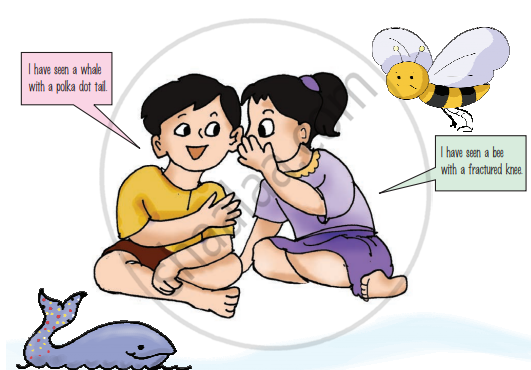
Now talk about the secret aloud.
Listen to your favourite advertisement on the radio or T.V. Repeat it with stress on the words. Act, draw and write the advertisement.
In small groups one child will give directions orally only once; the others will listen and hunt for the following:
First, read the following sets of limericks with missing words. Now, listen to them being read out aloud by your teacher or played on the recorder. As you enjoy the absurd fun, complete the verse with what you hear. You may listen to them again, if required.
I
A wonderful bird is the (i) ______His beak can hold more than his (ii) ______can. He can hold in his beak Enough food for a (iii) ______! But I’ll be darned if I know how the Peli-can?
II
There once was a (iv) ______ at the zoo Who always had something to do When it (v) ______ him, you know, To go to and fro, He (vi) ______ it and went fro and to.
III
There once was a (vii) _______ little bunny Who I thought was sweet and (viii) ______ He ate all the carrots, And looked at the (ix) ______ And that was my cute little (x) ______.
______ was one of the places visited by Mahesh.
