Advertisements
Advertisements
प्रश्न
In trapezium ABCD, AB || DC, E and F are points on non-parallel sides AD and BC respectively, such that EF || AB. Show that = `"AE"/"ED" = "BF"/"FC"`
Advertisements
उत्तर
Given: ABCD is a trapezium AB || DC
E and F are the points on the side of AD and BC
EF || AB
To Prove: `"AE"/"ED" = "BF"/"FC"`

Construction: Join AC intersecting AC at P
Proof:
In ∆ABC, PF || AB ...(Given)
By basic proportionality theorem
`"AP"/"PC" = "BF"/"FC"` ...(1)
In the ∆ACD, PE || CD ...(Given)
By basic Proportionality theorem
`"AP"/"PC" = "AE"/"ED"` ...(2)
From (1) and (2) we get
`"AE"/"ED" = "BF"/"FC"`
APPEARS IN
संबंधित प्रश्न
In ∆ABC, D and E are points on the sides AB and AC respectively such that DE || BC
If `"AD"/"DB" = 3/4` and AC = 15 cm find AE
In ∆ABC, D and E are points on the sides AB and AC respectively such that DE || BC
If AD = 8x – 7, DB = 5x – 3, AE = 4x – 3 and EC = 3x – 1, find the value of x
In ΔABC, D and E are points on the sides AB and AC respectively. For the following case show that DE || BC
AB = 12 cm, AD = 8 cm, AE = 12 cm and AC = 18 cm
In ΔABC, D and E are points on the sides AB and AC respectively. For the following case show that DE || BC
AB = 5.6 cm, AD = 1.4 cm, AC = 7.2 cm and AE = 1.8 cm.
If PQ || BC and PR || CD prove that `"AR"/"AD" = "AQ"/"AB"`
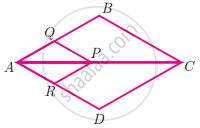
If PQ || BC and PR || CD prove that `"QB"/"AQ" = "DR"/"AR"`
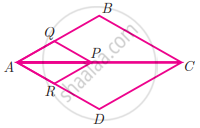
ABCD is a quadrilateral in which AB = AD, the bisector of ∠BAC and ∠CAD intersect the sides BC and CD at the points E and F, respectively. Prove that EF || BD.
Construct a ∆PQR such that QR = 6.5 cm, ∠P = 60° and the altitude from P to QR is of length 4.5 cm
An Emu which is 8 feet tall is standing at the foot of a pillar which is 30 feet high. It walks away from the pillar. The shadow of the Emu falls beyond Emu. What is the relation between the length of the shadow and the distance from the Emu to the pillar?
Two circles intersect at A and B. From a point, P on one of the circles lines PAC and PBD are drawn intersecting the second circle at C and D. Prove that CD is parallel to the tangent at P.
