Advertisements
Advertisements
प्रश्न
In trapezium ABCD, AB || DC, E and F are points on non-parallel sides AD and BC respectively, such that EF || AB. Show that = `"AE"/"ED" = "BF"/"FC"`
Advertisements
उत्तर
Given: ABCD is a trapezium AB || DC
E and F are the points on the side of AD and BC
EF || AB
To Prove: `"AE"/"ED" = "BF"/"FC"`

Construction: Join AC intersecting AC at P
Proof:
In ∆ABC, PF || AB ...(Given)
By basic proportionality theorem
`"AP"/"PC" = "BF"/"FC"` ...(1)
In the ∆ACD, PE || CD ...(Given)
By basic Proportionality theorem
`"AP"/"PC" = "AE"/"ED"` ...(2)
From (1) and (2) we get
`"AE"/"ED" = "BF"/"FC"`
APPEARS IN
संबंधित प्रश्न
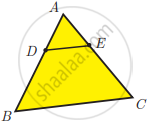
In ∆ABC, D and E are points on the sides AB and AC respectively such that DE || BC
If `"AD"/"DB" = 3/4` and AC = 15 cm find AE
In ∆ABC, D and E are points on the sides AB and AC respectively such that DE || BC
If AD = 8x – 7, DB = 5x – 3, AE = 4x – 3 and EC = 3x – 1, find the value of x
ABCD is a trapezium in which AB || DC and P, Q are points on AD and BC respectively, such that PQ || DC if PD = 18 cm, BQ = 35 cm and QC = 15 cm, find AD
In ΔABC, D and E are points on the sides AB and AC respectively. For the following case show that DE || BC
AB = 5.6 cm, AD = 1.4 cm, AC = 7.2 cm and AE = 1.8 cm.
Check whether AD is bisector of ∠A of ∆ABC of the following
AB = 4 cm, AC = 6 cm, BD = 1.6 cm and CD = 2.4 cm.
∠QPR = 90°, PS is its bisector. If ST ⊥ PR, prove that ST × (PQ + PR) = PQ × PR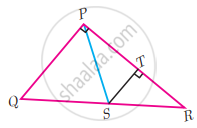
ABCD is a quadrilateral in which AB = AD, the bisector of ∠BAC and ∠CAD intersect the sides BC and CD at the points E and F, respectively. Prove that EF || BD.
Construct a ∆PQR in which the base PQ = 4.5 cm, ∠R = 35° and the median from R to RG is 6 cm.
Construct a ∆PQR such that QR = 6.5 cm, ∠P = 60° and the altitude from P to QR is of length 4.5 cm
ABC is a triangle in which AB = AC. Points D and E are points on the side AB and AC respectively such that AD = AE. Show that the points B, C, E and D lie on a same circle