Advertisements
Advertisements
प्रश्न
Draw ∆PQR such that PQ = 6.8 cm, vertical angle is 50° and the bisector of the vertical angle meets the base at D where PD = 5.2 cm
Advertisements
उत्तर
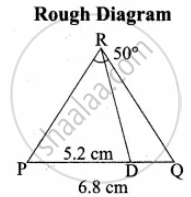
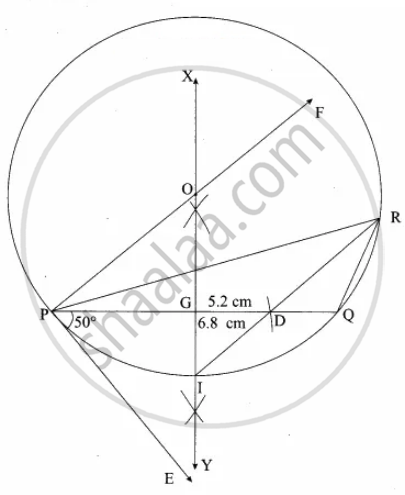
Steps of construction:
1. Draw a line segment PQ = 6.8 cm.
2. At P draw PE such that ∠QPE = 50°.
3. At P draw PF such that ∠EPF = 90°.
4. Draw the perpendicular bisector to PQ which intersects PF at O and PQ at G.
5. With O as centre and OP as radius draw a circle.
6. From P mark an arc of 5.2 cm on PQ at D.
7. The perpendicular bisector intersects the circle at I. Join ID.
8. ID produced meets the circle at A. Now Joint PR and QR. This ∆PQR is the required triangle.
APPEARS IN
संबंधित प्रश्न
In ∆ABC, D and E are points on the sides AB and AC respectively such that DE || BC
If AD = 8x – 7, DB = 5x – 3, AE = 4x – 3 and EC = 3x – 1, find the value of x
ABCD is a trapezium in which AB || DC and P, Q are points on AD and BC respectively, such that PQ || DC if PD = 18 cm, BQ = 35 cm and QC = 15 cm, find AD
If PQ || BC and PR || CD prove that `"AR"/"AD" = "AQ"/"AB"`
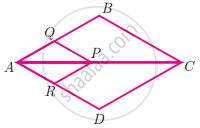
Rhombus PQRB is inscribed in ΔABC such that ∠B is one of its angle. P, Q and R lie on AB, AC and BC respectively. If AB = 12 cm and BC = 6 cm, find the sides PQ, RB of the rhombus.
DE || BC and CD || EE Prove that AD2 = AB × AF
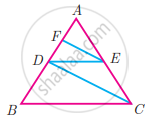
Check whether AD is bisector of ∠A of ∆ABC of the following
AB = 5 cm, AC = 10 cm, BD = 1.5 cm and CD = 3.5 cm
Check whether AD is bisector of ∠A of ∆ABC of the following
AB = 4 cm, AC = 6 cm, BD = 1.6 cm and CD = 2.4 cm.
∠QPR = 90°, PS is its bisector. If ST ⊥ PR, prove that ST × (PQ + PR) = PQ × PR
Construct a ∆PQR such that QR = 6.5 cm, ∠P = 60° and the altitude from P to QR is of length 4.5 cm
ST || QR, PS = 2 cm and SQ = 3 cm. Then the ratio of the area of ∆PQR to the area of ∆PST is