Advertisements
Advertisements
प्रश्न
∠QPR = 90°, PS is its bisector. If ST ⊥ PR, prove that ST × (PQ + PR) = PQ × PR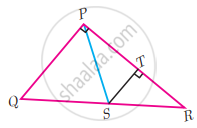
Advertisements
उत्तर
Given: ∠QPR = 90°; PS is the bisector of ∠P. ST ⊥ ∠PR
To prove: ST × (PQ + PR) = PQ × PR
Proof: In ∆PQR, PS is the bisector of ∠P.
∴ `"PQ"/"QR" = "QS"/"SR"`
Adding (1) on both side
`1 + "PQ"/"QR" = 1 + "QS"/"SR"`
`("PR" + "PQ")/"PR" = ("SR"+ "QS")/"SR"`
`("PQ" + "PR")/"PR" = "QR"/"SR"` ...(1)
In ∆RST And ∆RQP
∠SRT = ∠QRP = ∠R ...(Common)
∴ ∠QRP = ∠STR = 90°
∆RST ~ RQP ...(By AA similarity)
`"SR"/"QR" = "ST"/"PQ"`
`"QR"/"SR" = "PQ"/"ST"` ...(2)
From (1) and (2) we get
`("PQ" + "PR")/"PR" = "PQ"/"ST"`
ST × (PQ + PR) = PQ × PR
APPEARS IN
संबंधित प्रश्न
In ∆ABC, D and E are points on the sides AB and AC respectively such that DE || BC
If `"AD"/"DB" = 3/4` and AC = 15 cm find AE
In ∆ABC, D and E are points on the sides AB and AC respectively such that DE || BC
If AD = 8x – 7, DB = 5x – 3, AE = 4x – 3 and EC = 3x – 1, find the value of x
ABCD is a trapezium in which AB || DC and P, Q are points on AD and BC respectively, such that PQ || DC if PD = 18 cm, BQ = 35 cm and QC = 15 cm, find AD
In ΔABC, D and E are points on the sides AB and AC respectively. For the following case show that DE || BC
AB = 12 cm, AD = 8 cm, AE = 12 cm and AC = 18 cm
In ΔABC, D and E are points on the sides AB and AC respectively. For the following case show that DE || BC
AB = 5.6 cm, AD = 1.4 cm, AC = 7.2 cm and AE = 1.8 cm.
If PQ || BC and PR || CD prove that `"AR"/"AD" = "AQ"/"AB"`
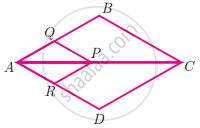
Rhombus PQRB is inscribed in ΔABC such that ∠B is one of its angle. P, Q and R lie on AB, AC and BC respectively. If AB = 12 cm and BC = 6 cm, find the sides PQ, RB of the rhombus.
ABCD is a quadrilateral in which AB = AD, the bisector of ∠BAC and ∠CAD intersect the sides BC and CD at the points E and F, respectively. Prove that EF || BD.
Construct a ∆ABC such that AB = 5.5 cm, ∠C = 25° and the altitude from C to AB is 4 cm
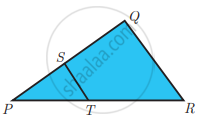
ST || QR, PS = 2 cm and SQ = 3 cm. Then the ratio of the area of ∆PQR to the area of ∆PST is