Advertisements
Advertisements
प्रश्न
In ,Δ ABC with usual notations prove that
b2 = c2 +a2 - 2 ca cos B
Advertisements
उत्तर
Consider that for Δ ABC , ∠B is in a standard position i.e. vertex B is at the origin and the side BC is along positive x-axis. As ∠B is an angle of a triangle ∴ ∠B can be acute or ∠B can be obtuse.
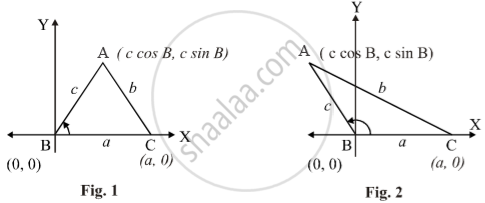
Using the Cartesian co-ordinate system in above figure.
we get B ≡(0,0) A ≡(c cos B , c sin B) and C ≡ (a,0)
Now consider l(CA) = b
∴ b2 = (a- c cos B)2 + (0-c sin B)2 , by distance formula
∴ b2 = a2 - 2 ac cos B + c2 cos2 B +c2 sin2 B
∴ b2 =a2 -2 ac cos B +c2 (sin2B + cos2B)
∴ b2 = a2 +c2 - 2 ac cos B
Hence proved.
APPEARS IN
संबंधित प्रश्न
In any ΔABC if a2 , b2 , c2 are in arithmetic progression, then prove that Cot A, Cot B, Cot C are in arithmetic progression.
In a Δ ABC, with usual notations prove that:` (a -bcos C) /(b -a cos C )= cos B/ cos A`
If in ∆ABC with usual notations a = 18, b = 24, c = 30 then sin A/2 is equal to
(A) `1/sqrt5`
(B) `1/sqrt10`
(C) `1/sqrt15`
(D) `1/(2sqrt5)`
In , ΔABC with usual notations prove that
(a-b)2 cos2 `("C"/2) +("a"+"b")^2 "sin"^2("C"/2) = "c"^2`
Find the polar co-ordinates of the point whose Cartesian co-ordinates are.
`(sqrt(2), sqrt(2))`
Find the polar co-ordinates of the point whose Cartesian co-ordinates are.
`(0, 1/2)`
In ΔABC, if cot A, cot B, cot C are in A.P. then show that a2, b2, c2 are also in A.P.
Solve the triangle in which a = `(sqrt3 + 1)`, b = `(sqrt3 - 1)` and ∠C = 60°.
In any ΔABC, prove the following:
`("c" - "b cos A")/("b" - "c cos A") = ("cos B")/("cos C")`
In any Δ ABC, prove the following:
ac cos B - bc cos A = a2 - b2
With the usual notations, show that
(c2 − a2 + b2) tan A = (a2 − b2 + c2) tan B = (b2 − c2 + a2) tan C
In Δ ABC, if a cos2 `"C"/2 + "c cos"^2 "A"/2 = "3b"/2`, then prove that a, b, c are in A.P.
Show that
`tan^-1(1/5) + tan^-1(1/7) + tan^-1(1/3) + tan^-1 (1/8) = pi/4.`
Solve: `tan^-1 ("1 - x"/"1 + x") = 1/2 (tan^-1 "x")`, for x > 0.
In ∆ABC, if a = 13, b = 14, c = 15, then find the value of cos B
In ΔABC, if a cos A = b cos B, then prove that ΔABC is either a right angled or an isosceles triangle.
In ΔABC, prove that `("a"^2sin("B" - "C"))/(sin"A") + ("b"^2sin("C" - "A"))/(sin"B") + ("c"^2sin("A" - "B"))/(sin"C")` = 0
In ∆ABC, if ∠A = `pi/2`, then prove that sin(B − C) = `("b"^2 - "c"^2)/("b"^2 + "c"^2)`
In a ΔABC if 2 cos C = sin B · cosec A, then ______.
In a ΔABC, `(sin "C"/2)/(cos(("A" - "B")/2))` = ______
If one side of a triangle is double the other and the angles opposite to these sides differ by 60°, then the triangle is ______
In Δ ABC; with usual notations, `("b" sin "B" - "c" sin "C")/(sin ("B - C"))` = _______.
In Δ ABC, with the usual notations, if `(tan "A"/2)(tan "B"/2) = 3/4` then a + b = ______.
In ΔABC, if `cosA/a = cosB/b,` then triangle ABC is ______
In ΔABC, a = 7cm, b = 3cm and c = 8 cm, then angle A is ______
The smallest angle of the ΔABC, when a = 7, b = `4sqrt(3)` and c = `sqrt(13)` is ______.
In ΔABC, if `"a" cos^2 "C"/2 + "c" cos^2 "A"/2 = (3"b")/2`, then a, b, c are in ______.
In a triangle ABC, b = `sqrt3`, c = 1 and ∠A = 30°, then the largest angle of the triangle is ______
If a = 13, b = 14, c = 15, then `cos("A"/2)` = ______.
In a ΔABC, if a = `sqrt(2)` x and b = 2y and ∠C = 135°, then the area of triangle is ______.
Find the cartesian co-ordinates of the point whose polar co-ordinates are `(1/2, π/3)`.
In ΔABC with usual notations, if ∠A = 30° and a = 5, then `s/(sumsinA)` is equal to ______.
In a triangle ABC, in usual notation, (a + b + c)(b + c – a) = λbc will be true if ______.
In any ΔABC, prove that:
(b + c) cos A + (c + a) cos B + (a + b) cos C = a + b + c.
If in ΔABC, `sin A/2 * sin C/2 = sin B/2` and 2s is the perimeter of the triangle, then s = ______.
