Advertisements
Advertisements
प्रश्न
If points A, B and C have position vectors `2hati, hatj` and `2hatk` respectively, then show that ΔABC is an isosceles triangle.
Advertisements
उत्तर
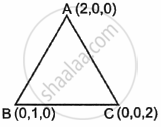
Using distance formula
AB = `sqrt((0 - 2)^2 + (1 - 0)^2 + (0 - 0)^2`
= `sqrt(4 + 1)`
AB = `sqrt(5)` units
BC = `sqrt((0 - 0)^2 + (0 - 1)^2 + (2 - 0)^2`
= `sqrt(1 + 4)`
= `sqrt(5)`
BC = `sqrt(5)` units
AC = `sqrt((0 - 2)^2 + (0 - 0)^2 + (2 - 0)^2`
= `sqrt(4 + 4)`
= `2sqrt(2)`
∵ AB = BC = `sqrt(5) ≠ AC`
`\implies` ΔABC is an isosceles triangle.
APPEARS IN
संबंधित प्रश्न
Find the direction ratios of a vector perpendicular to the two lines whose direction ratios are -2, 1, -1, and -3, -4, 1.
Find the position vector of the foot of perpendicular and the perpendicular distance from the point P with position vector
`2hati+3hatj+4hatk` to the plane `vecr` . `(2hati+hatj+3hatk)−26=0` . Also find image of P in the plane.
Find the value of 'p' for which the vectors `3hati+2hatj+9hatk and hati-2phatj+3hatk` are parallel
Find the direction cosines of the vector `hati + 2hatj + 3hatk`.
Show that the vector `hati + hatj + hatk` is equally inclined to the axes OX, OY, and OZ.
Show that the points A, B and C with position vectors `veca = 3hati - 4hatj - 4hatk`, `vecb = 2hati - hatj + hatk` and `vecc = hati - 3hatj - 5hatk`, respectively form the vertices of a right angled triangle.
Find a vector of magnitude 4 units which is parallel to the vector \[\sqrt{3} \hat{i} + \hat{j}\]
Find the angle between the vectors \[\vec{a} \text{ and } \vec{b}\] where \[\vec{a} = \hat{i} - \hat{j} \text{ and } \vec{b} = \hat{j} + \hat{k}\]
Find the angle between the vectors \[\vec{a} \text{ and } \vec{b}\] \[\vec{a} = 3\hat{i} - 2\hat{j} - 6\hat{k} \text{ and } \vec{b} = 4 \hat{i} - \hat{j} + 8 \hat{k}\]
Find the angle between the vectors \[\vec{a} \text{ and } \vec{b}\] \[\vec{a} = 2\hat{i} - \hat{j} + 2\hat{k} \text{ and } \vec{b} = 4\hat{i} + 4 \hat{j} - 2\hat{k}\]
Find a unit vector parallel to the vector \[\hat{i} + \sqrt{3} \hat{j}\]
Find the angle between the vectors \[\vec{a} = 2 \hat{i} - 3 \hat{j} + \hat{k} \text{ and } \vec{b} = \hat{i} + \hat{j} - 2 \hat{k}\]
Dot product of a vector with \[\hat{i} + \hat{j} - 3\hat{k} , \hat{i} + 3\hat{j} - 2 \hat{k} \text{ and } 2 \hat{i} + \hat{j} + 4 \hat{k}\] are 0, 5 and 8 respectively. Find the vector.
If \[\hat{a} \text{ and } \hat{b}\] are unit vectors inclined at an angle θ, prove that \[\cos\frac{\theta}{2} = \frac{1}{2}\left| \hat{a} + \hat{b} \right|\]
Show that the vectors \[\vec{a} = \frac{1}{7}\left( 2 \hat{i} + 3 \hat{j} + 6 \hat{k} \right), \vec{b} = \frac{1}{7}\left( 3\hat{i} - 6 {j} + 2 \hat{k} \right), \vec{c} = \frac{1}{7}\left( 6 \hat{i} + 2 \hat{j} - 3 {k} \right)\] are mutually perpendicular unit vectors.
If \[\vec{a} = 2 \hat{i} - \hat{j} + \hat{k}\] \[\vec{b} = \hat{i} + \hat{j} - 2 \hat{k}\] \[\vec{c} = \hat{i} + 3 \hat{j} - \hat{k}\] find λ such that \[\vec{a}\] is perpendicular to \[\lambda \vec{b} + \vec{c}\]
If \[\vec{\alpha} = 3 \hat{i} + 4 \hat{j} + 5 \hat{k} \text{ and } \vec{\beta} = 2 \hat{i} + \hat{j} - 4 \hat{k} ,\] then express \[\vec{\beta}\] in the form of \[\vec{\beta} = \vec{\beta_1} + \vec{\beta_2} ,\] where \[\vec{\beta_1}\] is parallel to \[\vec{\alpha} \text{ and } \vec{\beta_2}\] is perpendicular to \[\vec{\alpha}\]
If \[\vec{a} = 2 \hat{i} + 2 \hat{j} + 3 \hat{k} , \vec{b} = - \hat{i} + 2 \hat{j} + \hat{k} \text{ and } \vec{c} = 3 \hat{i} + \hat{j}\] \[\vec{a} + \lambda \vec{b}\] is perpendicular to \[\vec{c}\] then find the value of λ.
Show that the points whose position vectors are \[\vec{a} = 4 \hat{i} - 3 \hat{j} + \hat{k} , \vec{b} = 2 \hat{i} - 4 \hat{j} + 5 \hat{k} , \vec{c} = \hat{i} - \hat{j}\] form a right triangle.
Find the value of x for which \[x \left( \hat{i} + \hat{j} + \hat{k} \right)\] is a unit vector.
If \[\vec{a} \times \vec{b} = \vec{c} \times \vec{d} \text { and } \vec{a} \times \vec{c} = \vec{b} \times \vec{d}\] , show that \[\vec{a} - \vec{d}\] is parallel to \[\vec{b} - \vec{c}\] where \[\vec{a} \neq \vec{d} \text { and } \vec{b} \neq \vec{c}\] .
if `hat"i" + hat"j" + hat"k", 2hat"i" + 5hat"j", 3hat"i" + 2 hat"j" - 3hat"k" and hat"i" - 6hat"j" - hat"k"` respectively are the position vectors A, B, C and D, then find the angle between the straight lines AB and CD. Find whether `vec"AB" and vec"CD"` are collinear or not.
Which physical quantity has magnitude only?
Geometrically, a vector is represented by which of the following?
Which notation can be used for the magnitude of vector \[\vec{AB}\]?
Which expression gives the magnitude of the position vector \[\vec{OP}\] for \[P(x,y,z)\]?
