Advertisements
Advertisements
प्रश्न
If points A, B and C have position vectors `2hati, hatj` and `2hatk` respectively, then show that ΔABC is an isosceles triangle.
Advertisements
उत्तर
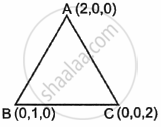
Using distance formula
AB = `sqrt((0 - 2)^2 + (1 - 0)^2 + (0 - 0)^2`
= `sqrt(4 + 1)`
AB = `sqrt(5)` units
BC = `sqrt((0 - 0)^2 + (0 - 1)^2 + (2 - 0)^2`
= `sqrt(1 + 4)`
= `sqrt(5)`
BC = `sqrt(5)` units
AC = `sqrt((0 - 2)^2 + (0 - 0)^2 + (2 - 0)^2`
= `sqrt(4 + 4)`
= `2sqrt(2)`
∵ AB = BC = `sqrt(5) ≠ AC`
`\implies` ΔABC is an isosceles triangle.
APPEARS IN
संबंधित प्रश्न
Find the direction ratios of a vector perpendicular to the two lines whose direction ratios are -2, 1, -1, and -3, -4, 1.
Write the position vector of the point which divides the join of points with position vectors `3veca-2vecb and 2veca+3vecb` in the ratio 2 : 1.
Two collinear vectors are always equal in magnitude.
Two vectors having the same magnitude are collinear.
Two collinear vectors having the same magnitude are equal.
Find the direction cosines of the vector joining the points A (1, 2, -3) and B (-1, -2, 1) directed from A to B.
Show that the vector `hati + hatj + hatk` is equally inclined to the axes OX, OY, and OZ.
If θ is the angle between two vectors `veca` and `vecb`, then `veca . vecb >= 0` only when ______.
Find the angle between the vectors \[\vec{a} \text{ and } \vec{b}\] \[\vec{a} = 2\hat{i} - \hat{j} + 2\hat{k} \text{ and } \vec{b} = 4\hat{i} + 4 \hat{j} - 2\hat{k}\]
If \[\hat{a} \text{ and } \hat{b}\] are unit vectors inclined at an angle θ, prove that \[\cos\frac{\theta}{2} = \frac{1}{2}\left| \hat{a} + \hat{b} \right|\]
If \[\hat{ a } \text{ and } \hat{b }\] are unit vectors inclined at an angle θ, prove that
\[\tan\frac{\theta}{2} = \frac{\left| \hat{a} -\hat{b} \right|}{\left| \hat{a} + \hat{b} \right|}\]
If \[\vec{a,} \vec{b,} \vec{c}\] are three mutually perpendicular unit vectors, then prove that \[\left| \vec{a} + \vec{b} + \vec{c} \right| = \sqrt{3}\]
Show that the vector \[\hat{i} + \hat{j} + \hat{k}\] is equally inclined to the coordinate axes.
Show that the vectors \[\vec{a} = \frac{1}{7}\left( 2 \hat{i} + 3 \hat{j} + 6 \hat{k} \right), \vec{b} = \frac{1}{7}\left( 3\hat{i} - 6 {j} + 2 \hat{k} \right), \vec{c} = \frac{1}{7}\left( 6 \hat{i} + 2 \hat{j} - 3 {k} \right)\] are mutually perpendicular unit vectors.
If \[\vec{p} = 5 \hat{i} + \lambda \hat{j} - 3 \hat{k} \text{ and } \vec{q} = \hat{i} + 3 \hat{j} - 5 \hat{k} ,\] then find the value of λ, so that \[\vec{p} + \vec{q}\] and \[\vec{p} - \vec{q}\] are perpendicular vectors.
If \[\vec{\alpha} = 3 \hat{i} + 4 \hat{j} + 5 \hat{k} \text{ and } \vec{\beta} = 2 \hat{i} + \hat{j} - 4 \hat{k} ,\] then express \[\vec{\beta}\] in the form of \[\vec{\beta} = \vec{\beta_1} + \vec{\beta_2} ,\] where \[\vec{\beta_1}\] is parallel to \[\vec{\alpha} \text{ and } \vec{\beta_2}\] is perpendicular to \[\vec{\alpha}\]
If either \[\vec{a} = \vec{0} \text{ or } \vec{b} = \vec{0}\] then \[\vec{a} \cdot \vec{b} = 0 .\] But the converse need not be true. Justify your answer with an example.
If \[\vec{a} = 2 \hat{i} + 2 \hat{j} + 3 \hat{k} , \vec{b} = - \hat{i} + 2 \hat{j} + \hat{k} \text{ and } \vec{c} = 3 \hat{i} + \hat{j}\] \[\vec{a} + \lambda \vec{b}\] is perpendicular to \[\vec{c}\] then find the value of λ.
Find the angles of a triangle whose vertices are A (0, −1, −2), B (3, 1, 4) and C (5, 7, 1).
If A, B and C have position vectors (0, 1, 1), (3, 1, 5) and (0, 3, 3) respectively, show that ∆ ABC is right-angled at C.
Find the vector from the origin O to the centroid of the triangle whose vertices are (1, −1, 2), (2, 1, 3) and (−1, 2, −1).
Find the unit vector in the direction of vector \[\overrightarrow{PQ} ,\]
where P and Q are the points (1, 2, 3) and (4, 5, 6).
A vector `vec"r"` has magnitude 14 and direction ratios 2, 3, – 6. Find the direction cosines and components of `vec"r"`, given that `vec"r"` makes an acute angle with x-axis.
Find the sine of the angle between the vectors `vec"a" = 3hat"i" + hat"j" + 2hat"k"` and `vec"b" = 2hat"i" - 2hat"j" + 4hat"k"`.
The altitude through vertex C of a triangle ABC, with position vectors of vertices `veca, vecb, vecc` respectively is:
Find the direction ratio and direction cosines of a line parallel to the line whose equations are 6x − 12 = 3y + 9 = 2z − 2
A line l passes through point (– 1, 3, – 2) and is perpendicular to both the lines `x/1 = y/2 = z/3` and `(x + 2)/-3 = (y - 1)/2 = (z + 1)/5`. Find the vector equation of the line l. Hence, obtain its distance from the origin.
Find the position vector of a point R which divides the line joining two points P and Q whose position vectors are `hati + 2hatj - hatk` and `-hati + hatj + hatk` respectively, internally the ratio 2:1.
