Advertisements
Advertisements
प्रश्न
Write down a unit vector in XY-plane, making an angle of 30° with the positive direction of the x-axis.
Advertisements
उत्तर
Let OP lie in XY - plane so that ∠XOP = 30°, ∠POY = 60° and ∠POZ = 90°
∴ The direction cosines of OP are
< cos 30°, cos 60°, cos 90°>
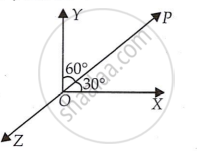
i.e., `< sqrt3/2, 1/2, 0>`
∴ `vec(OP) = sqrt3/2 hati + 1/2 hatj`
Now,
`|vec(OP) = sqrt((sqrt3/2)^2 + (1/2)^2)|`
`= sqrt(3/4 + 1/4)`
`= sqrt1`
= 1
Hence the required vectors is `sqrt3/2 hati + 1/2 hatj`
APPEARS IN
संबंधित प्रश्न
Find the direction ratios of a vector perpendicular to the two lines whose direction ratios are -2, 1, -1, and -3, -4, 1.
If `bara, barb, bar c` are the position vectors of the points A, B, C respectively and ` 2bara + 3barb - 5barc = 0` , then find the ratio in which the point C divides line segment AB.
Write the position vector of the point which divides the join of points with position vectors `3veca-2vecb and 2veca+3vecb` in the ratio 2 : 1.
Find the position vector of the foot of perpendicular and the perpendicular distance from the point P with position vector
`2hati+3hatj+4hatk` to the plane `vecr` . `(2hati+hatj+3hatk)−26=0` . Also find image of P in the plane.
Find the position vector of a point which divides the join of points with position vectors `veca-2vecb" and "2veca+vecb`externally in the ratio 2 : 1
If `bara, barb, barc` are position vectors of the points A, B, C respectively such that `3bara+ 5barb-8barc = 0`, find the ratio in which A divides BC.
Classify the following as scalar and vector quantity.
Time period
Two collinear vectors are always equal in magnitude.
Find the direction cosines of the vector `hati + 2hatj + 3hatk`.
Show that the vector `hati + hatj + hatk` is equally inclined to the axes OX, OY, and OZ.
Find the position vector of the mid point of the vector joining the points P (2, 3, 4) and Q (4, 1, – 2).
Show that the points A, B and C with position vectors `veca = 3hati - 4hatj - 4hatk`, `vecb = 2hati - hatj + hatk` and `vecc = hati - 3hatj - 5hatk`, respectively form the vertices of a right angled triangle.
Find the value of x for which `x(hati + hatj + hatk)` is a unit vector.
Let `veca` and `vecb` be two unit vectors, and θ is the angle between them. Then `veca + vecb` is a unit vector if ______.
ABCD is a parallelogram. If the coordinates of A, B, C are (−2, −1), (3, 0) and (1, −2) respectively, find the coordinates of D.
Find the angle between the vectors \[\vec{a} \text{ and } \vec{b}\] \[\vec{a} = 2\hat{i} - \hat{j} + 2\hat{k} \text{ and } \vec{b} = 4\hat{i} + 4 \hat{j} - 2\hat{k}\]
Find the angles which the vector \[\vec{a} = \hat{i} -\hat {j} + \sqrt{2} \hat{k}\] makes with the coordinate axes.
Dot product of a vector with \[\hat{i} + \hat{j} - 3\hat{k} , \hat{i} + 3\hat{j} - 2 \hat{k} \text{ and } 2 \hat{i} + \hat{j} + 4 \hat{k}\] are 0, 5 and 8 respectively. Find the vector.
If \[\vec{p} = 5 \hat{i} + \lambda \hat{j} - 3 \hat{k} \text{ and } \vec{q} = \hat{i} + 3 \hat{j} - 5 \hat{k} ,\] then find the value of λ, so that \[\vec{p} + \vec{q}\] and \[\vec{p} - \vec{q}\] are perpendicular vectors.
If either \[\vec{a} = \vec{0} \text{ or } \vec{b} = \vec{0}\] then \[\vec{a} \cdot \vec{b} = 0 .\] But the converse need not be true. Justify your answer with an example.
Find the magnitude of two vectors \[\vec{a} \text{ and } \vec{b}\] that are of the same magnitude, are inclined at 60° and whose scalar product is 1/2.
If A, B and C have position vectors (0, 1, 1), (3, 1, 5) and (0, 3, 3) respectively, show that ∆ ABC is right-angled at C.
Find the unit vector in the direction of vector \[\overrightarrow{PQ} ,\]
where P and Q are the points (1, 2, 3) and (4, 5, 6).
If \[\overrightarrow{AO} + \overrightarrow{OB} = \overrightarrow{BO} + \overrightarrow{OC} ,\] prove that A, B, C are collinear points.
Show that the vectors \[2 \hat{i} - 3 \hat{j} + 4 \hat{k}\text{ and }- 4 \hat{i} + 6 \hat{j} - 8 \hat{k}\] are collinear.
A vector `vec"r"` has magnitude 14 and direction ratios 2, 3, – 6. Find the direction cosines and components of `vec"r"`, given that `vec"r"` makes an acute angle with x-axis.
Position vector of a point P is a vector whose initial point is origin.
The unit normal to the plane 2x + y + 2z = 6 can be expressed in the vector form as
Let (h, k) be a fixed point where h > 0, k > 0. A straight line passing through this point cuts the positive direction of the coordinate axes at the points P and Q. Then the minimum area of the ΔOPQ. O being the origin, is
Find the direction ratio and direction cosines of a line parallel to the line whose equations are 6x − 12 = 3y + 9 = 2z − 2
Assertion (A): If a line makes angles α, β, γ with positive direction of the coordinate axes, then sin2 α + sin2 β + sin2 γ = 2.
Reason (R): The sum of squares of the direction cosines of a line is 1.
If points A, B and C have position vectors `2hati, hatj` and `2hatk` respectively, then show that ΔABC is an isosceles triangle.
Find the position vector of a point R which divides the line joining two points P and Q whose position vectors are `hati + 2hatj - hatk` and `-hati + hatj + hatk` respectively, internally the ratio 2:1.
Geometrically, a vector is represented by which of the following?
In the vector \[\vec{AB}\], what are A and B respectively?
Which notation can be used for the magnitude of vector \[\vec{AB}\]?
