Advertisements
Advertisements
प्रश्न
If a, b, c are in A.P,; b, c, d are in G.P and ` 1/c, 1/d,1/e` are in A.P. prove that a, c, e are in G.P.
Advertisements
उत्तर
It is given that a, b, c are in A.P.
∴ b – a = c – b … (1)
It is given that b, c, d, are in G.P.
∴ c2 = bd … (2)
Also ` 1/c, 1/d,1/e` are in A.P.
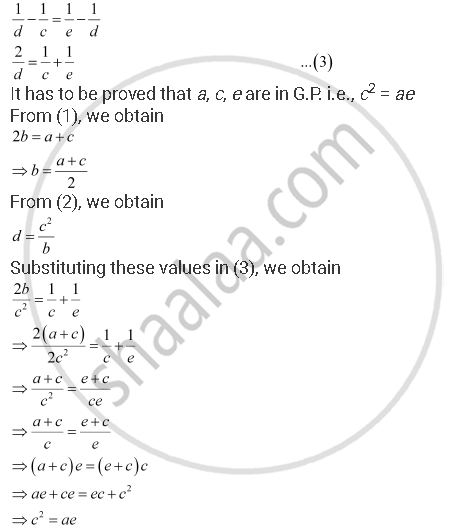
Thus, a, c, and e are in G.P.
संबंधित प्रश्न
Which term of the following sequence:
`1/3, 1/9, 1/27`, ...., is `1/19683`?
Show that the products of the corresponding terms of the sequences a, ar, ar2, …arn – 1 and A, AR, AR2, … `AR^(n-1)` form a G.P, and find the common ratio
The sum of some terms of G.P. is 315 whose first term and the common ratio are 5 and 2, respectively. Find the last term and the number of terms.
If 5th, 8th and 11th terms of a G.P. are p. q and s respectively, prove that q2 = ps.
In a GP the 3rd term is 24 and the 6th term is 192. Find the 10th term.
Find the sum of the following geometric series:
`3/5 + 4/5^2 + 3/5^3 + 4/5^4 + ....` to 2n terms;
How many terms of the series 2 + 6 + 18 + ... must be taken to make the sum equal to 728?
How many terms of the sequence \[\sqrt{3}, 3, 3\sqrt{3},\] ... must be taken to make the sum \[39 + 13\sqrt{3}\] ?
The common ratio of a G.P. is 3 and the last term is 486. If the sum of these terms be 728, find the first term.
Find the sum :
\[\sum^{10}_{n = 1} \left[ \left( \frac{1}{2} \right)^{n - 1} + \left( \frac{1}{5} \right)^{n + 1} \right] .\]
Let an be the nth term of the G.P. of positive numbers.
Let \[\sum^{100}_{n = 1} a_{2n} = \alpha \text { and } \sum^{100}_{n = 1} a_{2n - 1} = \beta,\] such that α ≠ β. Prove that the common ratio of the G.P. is α/β.
Find the sum of the following series to infinity:
10 − 9 + 8.1 − 7.29 + ... ∞
If Sp denotes the sum of the series 1 + rp + r2p + ... to ∞ and sp the sum of the series 1 − rp + r2p − ... to ∞, prove that Sp + sp = 2 . S2p.
If a, b, c are in G.P., prove that:
\[\frac{1}{a^2 - b^2} + \frac{1}{b^2} = \frac{1}{b^2 - c^2}\]
If a, b, c, d are in G.P., prove that:
(b + c) (b + d) = (c + a) (c + d)
If a, b, c, d are in G.P., prove that:
(a2 + b2 + c2), (ab + bc + cd), (b2 + c2 + d2) are in G.P.
If (a − b), (b − c), (c − a) are in G.P., then prove that (a + b + c)2 = 3 (ab + bc + ca)
If \[\frac{1}{a + b}, \frac{1}{2b}, \frac{1}{b + c}\] are three consecutive terms of an A.P., prove that a, b, c are the three consecutive terms of a G.P.
If pth, qth and rth terms of an A.P. and G.P. are both a, b and c respectively, show that \[a^{b - c} b^{c - a} c^{a - b} = 1\]
Insert 5 geometric means between 16 and \[\frac{1}{4}\] .
If the fifth term of a G.P. is 2, then write the product of its 9 terms.
If the sum of an infinite decreasing G.P. is 3 and the sum of the squares of its term is \[\frac{9}{2}\], then write its first term and common difference.
The fractional value of 2.357 is
For the G.P. if a = `2/3`, t6 = 162, find r.
The number of bacteria in a culture doubles every hour. If there were 50 bacteria originally in the culture, how many bacteria will be there at the end of 5th hour?
For the following G.P.s, find Sn.
p, q, `"q"^2/"p", "q"^3/"p"^2,` ...
For the following G.P.s, find Sn.
`sqrt(5)`, −5, `5sqrt(5)`, −25, ...
If Sn, S2n, S3n are the sum of n, 2n, 3n terms of a G.P. respectively, then verify that Sn (S3n – S2n) = (S2n – Sn)2.
Determine whether the sum to infinity of the following G.P.s exist, if exists find them:
`-3, 1, (-1)/3, 1/9, ...`
Find `sum_("r" = 0)^oo (-8)(-1/2)^"r"`
Answer the following:
Find the nth term of the sequence 0.6, 0.66, 0.666, 0.6666, ...
Answer the following:
If p, q, r, s are in G.P., show that (p2 + q2 + r2) (q2 + r2 + s2) = (pq + qr + rs)2
In a G.P. of positive terms, if any term is equal to the sum of the next two terms. Then the common ratio of the G.P. is ______.
Let S be the sum, P be the product and R be the sum of the reciprocals of 3 terms of a G.P. Then P2 R3 : S3 is equal to ______.
If x, 2y, 3z are in A.P., where the distinct numbers x, y, z are in G.P. then the common ratio of the G.P. is ______.
The lengths of three unequal edges of a rectangular solid block are in G.P. The volume of the block is 216 cm3 and the total surface area is 252cm2. The length of the longest edge is ______.
The sum of the infinite series `1 + 5/6 + 12/6^2 + 22/6^3 + 35/6^4 + 51/6^5 + 70/6^6 + ....` is equal to ______.
For an increasing G.P. a1, a2 , a3 ........., an, if a6 = 4a4, a9 – a7 = 192, then the value of `sum_(i = 1)^∞ 1/a_i` is ______.
If the expansion in powers of x of the function `1/((1 - ax)(1 - bx))` is a0 + a1x + a2x2 + a3x3 ....... then an is ______.
